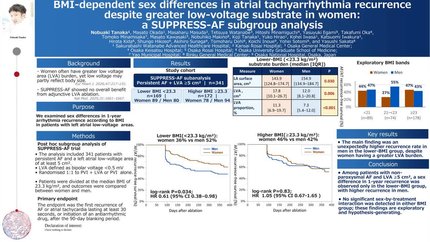
Identifying suitable candidates for left atrial low-voltage area ablation in persistent atrial fibrillation: a post-hoc analysis of the SUPPRESS-AF trial
European Heart Journal


Abstract
The efficacy of catheter ablation (CA) for persistent atrial fibrillation (PerAF) remains suboptimal with pulmonary vein isolation (PVI) alone. Left atrial (LA) low-voltage area (LVA) ablation has emerged as a potential strategy to improve outcomes. Although the SUPPRESS-AF randomized controlled trial did not demonstrate the overall superiority of additional LVA ablation, subgroups analyses indicated that certain patients cohort may derive greater benefit. This study aimed to identify patients suitable for additional LVA ablation in PerAF.
This post-hoc sub-analysis of the SUPPRESS-AF multicenter randomized controlled trial included patients with PerAF undergoing initial CA. After PVI, those with LVAs, defined as regions with a bipolar peak-to-peak voltage <0.5 mV covering ≥5 cm² of the LA surface, were randomly assigned in a 1:1 ratio to either receive additional LVA ablation (PVI+LVA ablation arm) or undergo PVI alone (PVI-alone arm).
In a prespecified subgroup analysis, factors associated with a lower AF/atrial tachycardia (AT) recurrence rate in the PVI+LVA ablation arm compared to the PVI-alone arm included age ≥75 years, NYHA functional class ≥II, LA diameter ≥45 mm, absence of diabetes, and LVA size ≥20 cm². Each factor was assigned 1 point and total score was defined as the effective LVA ablation (ELVA-ABL score). The association between the ELVA-ABL score and AF/AT recurrence was analyzed in the PVI+LVA-ABL arm. Receiver operating characteristic (ROC) analysis was used to determine the optimal ELVA-ABL score cutoff for predicting AF/AT recurrence. Kaplan-Meier survival analysis and Cox proportional hazards models were used to assess AF/AT-free survival between the PVI+LVA-ABL and PVI-alone arms stratified by the ELVA-ABL score.
Among 1347 patients who underwent initial CA for PerAF, 343 (25.5%) patients with LVAs were assigned to PVI+LVA-ABL arm (n=170) or PVI-alone arm (n=171). In PVI+LVA-ABL group, ROC analysis identified an optimal ELVA-ABL score cutoff of 3 for predicting AF/AT recurrence. Patients with an ELVA-ABL score ≥ 3 demonstrated significantly better AF/AT-free survival in the PVI+LVA-ABL arm compared to the PVI-alone arm (HR: 0.63, 95% CI: 0.41–0.97, p=0.038). In contrast, patients with an ELVA-ABL score <3 showed no significant difference in outcomes between the PVI+LVA-ABL and PVI-alone arms (HR: 1.45, 95% CI: 0.80–2.61, p=0.222).(Figure)
This post-hoc sub-analysis of the SUPPRESS-AF trial suggests that LVA ablation improves outcomes in patients with a higher ELVA-ABL score. These findings may help refine patient selection criteria for LVA ablation in PerAF.
Contributors

N Kobayashi
Author
A Sugino
Author
M Abe
Author
H Nohara
Author
S Kawanami
Author
K Yasumoto
Author
N Okamoto
Author
Y Matsunaga-Lee
Author
M Yano
Author
M Nishino
Author
You may be interested in