HARBOR-AF: a multicentre, open-label, dose escalation study of the efficacy, safety, and tolerability of budiodarone for the treatment of subjects with paroxysmal atrial fibrillation
European Heart Journal


Abstract
Atrial fibrillation (AF) is a major public health challenge. Long episodes of AF (LEAF) ≥5.5 hours are linked to an increased risk of stroke, heart failure, and progression to permanent AF. Budiodarone, a novel antiarrhythmic agent, has shown promising Phase 2 results in reducing AF burden (AFB) and LEAF. Recent FDA feedback supports a rapid approval pathway that integrates tailored dose titration using FDA-approved wearable AF monitoring devices.
To assess the efficacy, safety, and tolerability of budiodarone in controlling AF symptoms and eliminating LEAF ≥5 hours and daily AFB ≥5 hours (21%) in subjects with non-permanent AF, thereby modernising and enabling effective AF rhythm management.
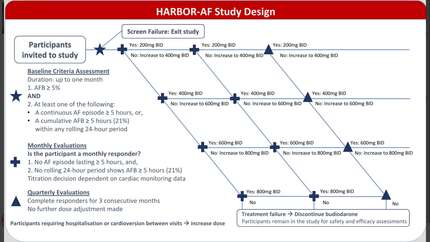
HARBOR-AF is a global, multicentre, open-label, dose-escalation Phase 3 study enrolling approximately 1,000 subjects with paroxysmal AF who meet predefined criteria during the 28-day run-in (AFB ≥5% and multiple LEAF ≥5.5 hours [or, 24-hour rolling period with cumulative AFB ≥5.5 hours (23%]). Subjects are continuously monitored using wearable devices (wristbands, chest patches, or implantable monitors) to capture AFB and LEAF data. All patients begin 12-month treatment period with 200 mg twice daily (BID) with subsequent dose escalation in 200 mg BID increments (up to 800 mg BID) based on monthly responder status—defined by the absence of LEAF ≥5 hours or 24-hour rolling cumulative AFB ≥5 hours (21%). Primary endpoints include the total number of episodes and hours in AF for episodes ≥5 hours (including cumulative durations ≥5 hours or 21% of monitoring time in any rolling 24-hour period) compared to baseline, and the percentage reduction as change from baseline in AFB over weeks 12–24 across all doses; secondary endpoints assess changes in LEAF episode duration, symptom scores, time in normal sinus rhythm, and rates of cardiovascular hospitalisations.
Interim data from the first 100 subjects are expected in the coming months, which will clarify the dose–response relationship and safety profile. The study aims to demonstrate that budiodarone—when titrated by real-time, wearable device monitoring—can safely reduce AF burden, eliminate harmful LEAF ≥5 hours and improve symptom control.
HARBOR-AF is poised to set a new standard of care for non-permanent AF by utilising real-time wearable device monitoring for precise, individualised dose titration. This landmark trial aims not only to control AF symptoms and reduce LEAF but also to potentially modify disease progression, heralding a modern approach to AF management. Image 1: HARBOR-AF Overall Study Design
Contributors


You may be interested in