Meta-analysis of the safety of outpatient sotalol initiation in clinical practice
European Heart Journal


Abstract
Sotalol is a class III anti-arrhythmic medication commonly used in maintaining sinus rhythm in patients with arrhythmias, most notably atrial fibrillation. Sotalol is conventionally initiated in an inpatient setting (typically three days) to allow close monitoring of its effects, particularly corrected QT interval (QTc) prolongation, which may predispose patients to fatal arrhythmias such as torsades de pointes.
In this meta-analysis, we aim to assess the safety of initiating sotalol in an outpatient setting.
We searched PubMed, Embase, Scopus, Web of Science and the Cochrane library for observational studies and randomized controlled trials assessing the safety of outpatient initiation of sotalol until February 2025. Our primary endpoint was the change from baseline in QTc interval at one month. Our secondary endpoints included the rates of adverse events after sotalol initiation. Standardized mean differences from baseline in QTc interval with 95% confidence intervals were pooled with a random-effects model using CMA V3 software.
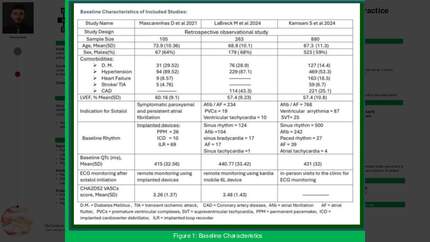
We included three observational studies with a total cohort of 1248 patients. The baseline characteristics of included studies are summarized in figure 1. At one month post sotalol initiation in an outpatient setting, there was no statistically significant change in QTc interval from baseline ( SMD = 0.152, 95% CI = -0.354 to 0.657, p = 0.557, I^2= 98% ) as illustrated in figure 2. The most frequent adverse events were bradycardia and fatigue with a very low incidence of QTc prolongation requiring discontinuation of the drug.
The initiation of Sotalol in an outpatient setting appears to be safe and associated with no significant adverse events. Although these results are promising, large randomized controlled trials are warranted to establish the safety and efficacy of outpatient initiation of sotalol. Baseline Characteristics QTc Change from Baseline.
Contributors


You may be interested in