Prevention of atrial fibrillation recurrence with vitamin C during catheter ablation
European Heart Journal


Abstract
Catheter ablation was regarded as the gold standard therapeutic approach for the treatment of AF [1]. Despite its efficacy, catheter ablation is limited due to the high rate of recurrence post-ablation,ranging from 12% to 48% within one year following the procedure[2]. Inflammation may promote atrial fibrillation (AF) recurrence after pulmonary vein isolation (PVI). However, no studies have examined the relationship between intravenous vitamin C administration and AF recurrence after PVI.
To evaluate the efficacy of intravenous vitamin C during catheter ablation (CA) for preventing atrial fibrillation (AF) recurrence after PVI.
A total of 248 patients were included and divided into two groups based on whether vitamin C was used during catheter ablation. Vitamin C used group were 154 patients, control group were 94 patients. We compared the one-year recurrence (late recurrence), longtime recurrence (>one-year, very late recurrence) and major adverse event. Atrial arrhythmia recurrence was defined as AF, atrial flutter, or atrial tachycardia >30 s by ECG or Holter. Major adverse event includes heart failure hospitalizations, strokes, permanent pacemaker implantation and all cause death.
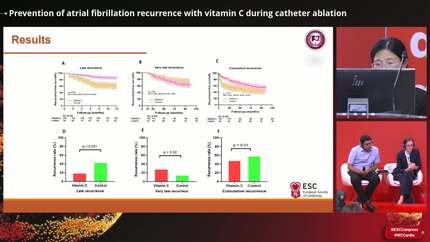
A total of 124 patients (50.0%) experienced recurrent arial fibrillation during a median follow-up of 94 months (IQR, 89–101 months). Among the 124 recurrent patients, 71/134 patients were in the vitamin C group (46.1% of the vitamin C group) and 53/134 patients were in the control group (56.4% of the control group). The cumulative incidence of AF recurrence was significantly lower in the vitamin C group than in the control group (p=0.01). In the recurrence group, 71 patients were late recurrence, including 30 cases in the vitamin C group (19.5% of the vitamin C group) and 41 cases in the control group (43.6% of the control group). Compared with the control group, the vitamin C group had a significantly lower late recurrence of AF (p<0.001). While, vitamin C did not prevent very late AF recurrence (26.6% versus 12.8%, P=0.22). A multivariate Cox regression analysis found that vitamin C was significantly associated with a decreased risk of AF recurrence after CA. There were no differences in the composite clinical outcomes of hospitalization for heart failure, stroke or cerebral hemorrhage, permanent pacemaker implantation and all cause death (HR 0.82 [95% CI, 0.29–2.29]; P=0.70) between vitamin C and control groups.
Intravenous vitamin C administration during AF catheter ablation may prevent late AF recurrence, but did not prevent very late AF recurrence during the long-term follow-up after PVI. Intravenous vitamin C during CA is an effective and safe treatment option for preventing late recurrence of AF after PVI. Graphic abstract

You may be interested in