Efficacy and safety of catheter ablation versus antiarrhythmic drug therapy in ventricular tachycardia management: a systematic review and meta-analysis
European Heart Journal


Abstract
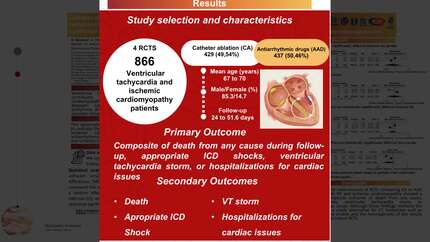
Ventricular tachycardia (VT) is a life-threatening arrhythmia, particularly in patients with structural heart disease. Standard management includes implantable cardioverter-defibrillators (ICDs) and antiarrhythmic drugs, but catheter ablation (CA) has emerged as a potential first-line therapy due to its ability to modify the arrhythmogenic substrate and reduce VT recurrence.
This systematic review and meta-analysis aimed to assess whether catheter ablation is superior to antiarrhythmic drug therapy in the management of VT, focusing on their impact on clinical outcomes and treatment strategies.
A systematic search was conducted in PubMed, Embase, and the Cochrane Central Register of Controlled Trials to identify randomized controlled trials (RCTs) comparing catheter ablation with antiarrhythmic drug therapy for VT management. Statistical analysis was carried out utilizing Review Manager version 5.4 and R version 4.2.2. Heterogeneity was assessed with I² statistics; p-values inferior to 0.05 and I²>25% were considered significant heterogeneity. The primary outcomes assessed included appropriate ICD shocks, recurrent VT, and all-cause mortality.
Ten RCTs met the inclusion criteria, encompassing 1,519 participants, of whom 748 underwent CA. The CA group showed a significant reduction in appropriate ICD shocks (RR 0.66; CI 0.50-0.88; p = 0.005; Figure 1A) and VT recurrence (RR 0.81; CI 0.70-0.92; p = 0.002; Figure 1B) compared to antiarrhythmic therapy. However, no significant difference was observed in all-cause mortality (RR 0.92; CI 0.73-1.14; p = 0.439; Figure 2).
This systematic review and meta-analysis suggest that catheter ablation is more effective than antiarrhythmic drug therapy in reducing VT recurrence and ICD interventions, but does not impact overall mortality.
Contributors


W De Oliveira
Author
N De Oliveira Neto
Author
D Cavalcante
Author
V Silva
Author
A L De Oliveira
Author
R Borges
Author
I Duarte
Author

N Carvalho
Author
You may be interested in