Isoproterenol testing as a risk stratification tool in arrhythmogenic mitral valve prolapse
European Heart Journal


Abstract
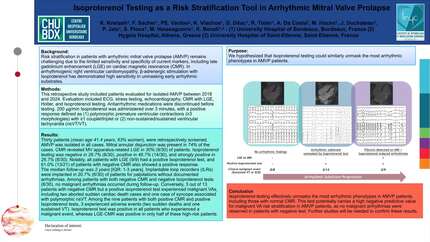
Risk stratification in patients with arrhythmogenic mitral valve prolapse (AMVP) remains challenging due to the limited sensitivity and specificity of current markers, including late gadolinium enhancement (LGE) on cardiac magnetic resonance (CMR). In arrhythmogenic right ventricular cardiomyopathy, β-adrenergic stimulation with Isoproterenol has demonstrated high sensitivity in unmasking early arrhythmogenic substrates.
We hypothesized that Isoproterenol testing could similarly unmask the most arrhythmogenic phenotypes in AMVP patients.
This retrospective study included patients evaluated for isolated AMVP at our institutions between 2018 and 2024. Patients with associated structural heart disease were excluded. Evaluation included ECG, stress testing, echocardiography, CMR with LGE, Holter monitoring, and Isoproterenol testing. Antiarrhythmic medications were discontinued before testing. Isoproterenol was administered at 200 µg/min for 3 minutes, with a positive response defined as (1) polymorphic premature ventricular contractions (≥3 morphologies) with ≥1 couplet/triplet or (2) nonsustained/sustained ventricular tachycardia (nsVT/VT).
Thirty patients with a mean age of 41.4 ± 13.5 years, of whom 63% were women, were retrospectively screened. AMVP was isolated in all cases. Mitral annular disjunction was present in 74% of the cases. CMR revealed MV apparatus-related LGE in 30% (9/30) of patients. Isoproterenol testing was negative in 26.7% (8/30), positive in 46.7% (14/30), and strongly positive in 26.7% (8/30). Notably, all patients with LGE (9/9) had a positive Isoproterenol test, and 61.0% (13/21) of patients with negative CMR also showed a positive response.
The median follow-up was 2 years [IQR: 1-3 years]. Implantable loop recorders (ILRs) were implanted in 20.7% (6/30) of patients for palpitations without documented arrhythmias. Among patients with both negative CMR and negative Isoproterenol tests (8/30), no malignant arrhythmias occurred during follow-up. Conversely, 3 out of 13 patients with negative CMR but a positive isoproterenol test experienced malignant VAs, including two aborted sudden cardiac death cases and one case of syncope associated with polymorphic nsVT. Among the nine patients with both positive CMR and positive Isoproterenol tests, 3 experienced adverse events (two sudden deaths and one sustained VT). Isoproterenol test was positive in all patients who experienced a malignant event, whereas LGE-CMR was positive in only half of these high-risk patients.
Isoproterenol testing effectively unmasks the most arrhythmogenic phenotypes in AMVP patients, including those with normal CMR. This test potentially carries a high negative predictive value for malignant VA risk stratification in AMVP patients, as no malignant arrhythmias were observed in patients with negative test. Further studies will be needed to confirm these results.
Contributors


P E Vardas
Author
K Vlachos
Author
G Ditac
Author
R Tixier
Author
A Da Costa
Author
M Hocini
Author
J Duchateau
Author
P Jais
Author
S Ploux
Author
M Haissaguerre
Author
K Benali
Author
You may be interested in