Atrial fibrillation burden in post-ablation period. Preliminary results from DIPE Registry on photoplethysmography-based heart rhythm monitoring after ablation of atrial fibrillation substrate
European Heart Journal


Abstract
Atrial fibrillation (AF) is the most common sustained arrhythmia. Catheter ablation (CA) is the standard invasive treatment, but AF recurs in 20–45%. Post-ablation monitoring helps correlate symptoms with heart rhythm and can be done using ECG-based methods or photoplethysmography (PPG), though ECG confirmation is required.
This study evaluates the feasibility and usability of trans-telephonic PPG-based heart rhythm monitoring with FibriCheck for three months post-CA and its efficacy compared to Holter-ECG at 3 months.
Patients with paroxysmal or persistent AF undergoing first-time CA used FibriCheck during the blanking period. Daily recordings were taken, with increased monitoring for one week per month. We assessed clinical variables, motivation (adherence to ≥3/day), AF ratio (urgent/total measurements), AF load (time in AF/total monitoring), and symptoms-rhythm correlation (symptomatic urgent + asymptomatic normal/total measurements).
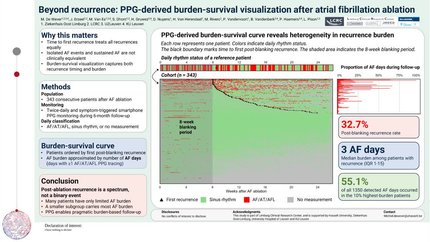
A total of 92 patients completed the study, with a median age of 64 (IQR 55-70), and 67.4% were male. Paroxysmal AF was present in 74 patients (80.4%). The median CHA₂DS₂-VA score was 2.00 (IQR 1-3). The median number of recorded measurements per patient was 105.5 (IQR: 73-155). Patients performed the highest number of measurements during the first month’s increased heart rhythm monitoring week (median: 22, IQR 18-25), with a decline in months two (19, IQR: 13-22) and three (16.5, IQR: 9-22). Motivation decreased from a median of 83.33% (IQR 50%-100%) in the first month to 50% (IQR 16.67%-83.33%) in the third month. AF recurrence was detected in 35 patients (38.89%) during the blanking period, dropping to 20% in months two and three. PPG monitoring was compared with standard Holter-ECG monitoring after a 3-month follow-up in 27 patients. The FibriCheck application showed a positive predictive value (PPV) of 96.3% (95% CI: 0.892, 1.000) for detecting AF recurrences compared to Holter-ECG. Patients with a history of persistent AF tended to have more urgent measurements suggestive of AF (32.11 vs 6.07, p = 0.0658) and a higher AF ratio (17.87% vs 3.89%, p = 0.0595), though the differences were not statistically significant. Patients with persistent AF had significantly higher AF load than those with paroxysmal AF (20.07% vs 3.37%, p = 0.0448). PPG monitoring showed a symptoms-rhythm correlation of 98.15% (IQR: 81.88%-100%) which may be a result of many asymptomatic patients with sinus rhythm during the blanking period.
PPG-based heart rhythm monitoring with FibriCheck for three months post-CA was feasible, with patients recording a substantial number of measurements. Motivation was highest in the first month but declined over time, highlighting challenges in maintaining long-term monitoring. PPG monitoring had a high PPV in detecting AF recurrences compared to Holter-ECG. Patients with persistent AF had significantly higher AF load than those with paroxysmal AF.
Contributors


M Wawrzenczyk
Author
A Skrobucha
Author
M Boszko
Author
K Rutkowski
Author
J Szydlik
Author
M Peller
Author
P Lodzinski
Author
P Balsam
Author
M Gawalko
Author
You may be interested in