Proactive atrial fibrillation screening in primary care: assessing the impact of a device-based approach
European Heart Journal


Abstract
Atrial fibrillation is the most frequent arrythmia. (1) The prevalence of atrial fibrillation in Europe is expected to double from 2010 to 2060. (2) AF is associated with increased risk of stroke five-fold (3), heart failure and dementia. (4,5) Gaps remain in the early identification of atrial fibrillation in high-risk populations within primary care. (4)
To determine the prevalence of device-detected atrial fibrillation (DDAF) among high-risk patients in primary care and to evaluate the feasibility and impact of systematic screening in routine primary care settings.
This was a 2-year prospective cohort study. A randomized sample of patients was selected based on the following inclusion criteria: (a) age 65-85 years, (b) no prior diagnosis of AF or history of stroke, but at high risk of developing AF. (6) Baseline assessment and clinical follow-up included evaluation of P-wave patterns on ECG using the Morphology-Voltage-P-wave (MVP) ECG risk score and assessment of left atrial (LA) size and function via 2D transthoracic echocardiography (TTE). Additionally, cardiac rhythm monitoring over a 14-day period was performed annually using a smartphone-based photoplethysmography (PPG) application for atrial fibrillation detection. The primary outcome was the new diagnosis of AF during follow-up. If the app indicated probable AF, an ECG was performed; if the ECG was negative, a Holter monitor was indicated.
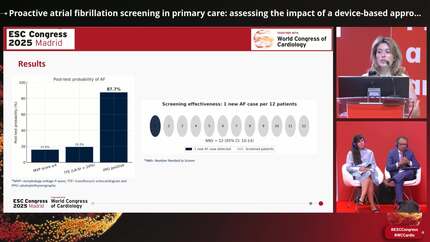
A total of 149 individuals aged >65 years at high risk of AF were recruited. The average age of participants was 74.7 years (SD 5.11), and 64.4% were women. CHA2DS2VA score mean was 3.9 (1.04). Thirteen new AF cases were confirmed during the follow-up period among the 149 high-risk individuals, corresponding to a number needed to screen (NNS) of 12 (95% CI 10-14). The post-test odds for an MVP score ≥4 was 15.9%; for TTE (LA-Sr < 26%), 19.3%; and for the smartphone-based photoplethysmography (PPG) application-positive individuals, 87.7%.
The results support the identification of high-risk individuals and the use of a smartphone-based photoplethysmography (PPG) application to improve the detection and diagnosis of AF in primary care.
Contributors


J L Clua-Espuny
Author
E Satue-Gracia
Author
F M Martin-Lujan
Author
D Gentille-Lorente
Author
M Palleja-Millan
Author
E Muria-Subirats
Author
T Forcadell-Arenas
Author
C De Diego-Cabanes
Author
D Ribas-Segui
Author
A Diaz-Vilarasau
Author
C Molins-Rojas
Author
You may be interested in