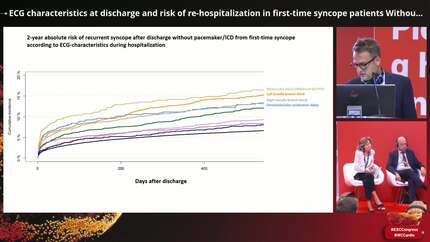
ECG characteristics at discharge and risk of re-hospitalization in first-time syncope patients Without Pacemaker or ICD: a nationwide Danish cohort study including over 70,000 patients
European Heart Journal


Abstract
First-time syncope accounts for a substantial proportion of emergency visits and hospital admissions, particularly in older adults. Many patients are discharged without pacemaker or implantable cardioverter-defibrillator (ICD) implantation, yet some experience recurrent syncope requiring re-hospitalization. The etiology of syncope varies from benign vasovagal episodes to serious conditions such as bradyarrhythmia and conduction abnormalities, making accurate diagnosis essential for proper management.
This study aims to characterize electrocardiographic (ECG) findings in patients with first-time syncope and evaluate the risk of recurrent syncope after hospital discharge without pacemaker or ICD implantation.
Using the Danish Nationwide ECG Cohort (between 2000–2022), we identified patients with a first-time syncope diagnosis (ICD-10: DR559) and an available ECG. All 10-second ECGs were analyzed using version 243 of the 12SL algorithm (GE Healthcare, Milwaukee, WI, USA). ECG characteristics included atrial fibrillation, first-degree atrioventricular block, bifascicular block, incomplete bundle branch block (both incomplete left and right bundle branch block), intraventricular conduction delay, left bundle branch block, left anterior and posterior fascicular block, and right bundle branch block.
Exclusion criteria were in-hospital mortality, age <18 years, prior pacemaker/ICD implantation or implantation during hospitalization, and second- or third-degree atrioventricular block. Patients were followed until recurrent syncope, death, end of follow-up, or pacemaker/ICD implantation.
Among 80,454 patients with first-time syncope and ECG data, 10,104 (12.5%) met exclusion criteria, leaving 70,350 for analysis. Patients were stratified by ECG findings: atrial fibrillation/flutter (n=3,794), first-degree atrioventricular block (n=4,836), bifascicular block (n=807), incomplete bundle branch block (n=2,001), intraventricular conduction delay (n=733), left bundle branch block (n=1,668), left anterior fascicular block (n=1,317), right bundle branch block (n=2,569), and no significant ECG changes (n=50,613).
Bifascicular block was associated with the highest risk of recurrent syncope (Hazard Ratio [HR]: 1.81; 95% Confidence Interval [CI]: 1.51–2.16), followed by left bundle branch block (HR: 1.56; 95% CI: 1.37–1.77) and right bundle branch block (HR: 1.42; 95% CI: 1.27–1.58).
In this large cohort, patients with first-time syncope and bifascicular block had the highest risk of recurrent syncope, followed by those with left and right bundle branch block. These findings highlight the need for targeted follow-up to prevent re-hospitalization in high-risk patients.
Contributors

M H El-Chouli
Author
C Binding
Author
C Polcwiartek
Author
K Kragholm
Author
D M Christensen
Author
M P Andersen
Author
C Torp-Pedersen
Author
C Graff
Author
A N Bonde
Author
You may be interested in