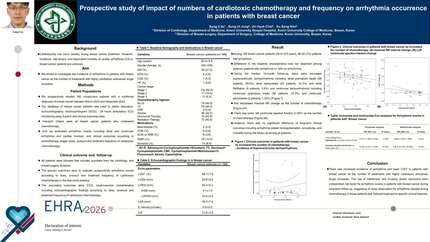
Prospective study of impact of cardiotoxic chemotherapy protocol and frequency on arrhythmia occurrence in patients with breast cancer
European Heart Journal


Abstract
Cardiotoxicity can occur acutely during breast cancer treatment. However, incidence, risk factors, and associated mortality of cardiac arrhythmia (CA) in breast cancer patients are unknown.
We aimed to investigate the incidence of arrhythmia in patients with breast cancer as the number of treatments with highly cardiotoxic anticancer drugs increases.
We prospectively studied 160 consecutive patients with a confirmed diagnosis of breast cancer between March 2023 and October 2024. Echocardiography and ambulatory electrocardiography monitoring (ECG, S-patch) were performed on all patients simultaneously at each stage of chemotherapy. And we compared echocardiographic parameters, arrhythmic events according to chemotherapy stages.
Among 160 breast cancer patients (55.4±9.9 years), 98 (61.2%) patients had arrhythmia. Difference in the baseline characteristics was not observed among patients (patients with arrhythmia vs. with no arrhythmia). During the median 12-month follow-up, there were increased supraventricular tachyarrhythmia including atrial premature beats (89 patients, 55.6%) atrial tachycardia (23 patients, 14.3%) and atrial fibrillation (9 patients, 5.6%) and ventricular tachyarrhythmia including ventricular premature beats (50 patients, 31.2%) and ventricular tachycardia (2 patients, 1.25%) [Figure 1A] and decreased maximal RR change as the number of chemotherapy (Figure 1B). And there was lower left ventricular ejection fraction (LVEF) as the number of chemotherapy (Figure 1C). However, there was no significant difference of long-term clinical outcomes including arrhythmia related re-hospitalization, procedures, and mortality during the follow-up among all patients.
There was increased incidence of arrhythmic events and decreased LVEF in patients with breast cancer as the number of treatments with highly cardiotoxic anticancer drugs increases supporting the close observation for arrhythmia needed during chemotherapy in patients with breast cancer and tailored treatment to specific clinical features.
Contributors

You may be interested in