Sex-specific analysis of atrial fibrillation in developing nations
European Heart Journal


Abstract
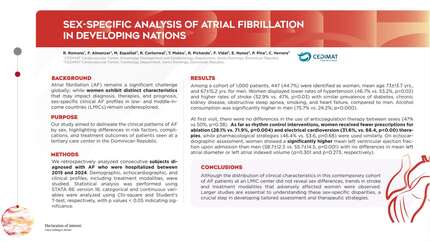
Atrial fibrillation (AF) remains a significant challenge globally; while women exhibit distinct characteristics that may impact diagnosis, therapies, and prognosis, sex-specific clinical AF profiles in low- and middle-income countries (LMICs) remain underexplored.
Our study aimed to delineate the clinical patterns of AF by sex, highlighting differences in risk factors, complications, and treatment outcomes of patients seen at a tertiary care center in the Dominican Republic.
We retrospectively analyzed consecutive subjects diagnosed with AF who were hospitalized between 2015 and 2024. Demographic, echocardiographic, and clinical profiles, including treatment modalities, were studied. Statistical analysis was performed using STATA BE version 18; categorical and continuous variables were analyzed using Chi-square and Student’s t-test, respectively, with p values < 0.05 indicating significance.
Among a cohort of 1,000 patients, 447 (44.7%) were identified as women, mean age 73±13.7 yrs., and 67±15.2 yrs. for men. Women displayed lower rates of hypertension (46.7% vs. 53.2%, p=0.02) and higher rates of stroke (52.9% vs. 47%, p=0.03) with similar prevalence of diabetes, chronic kidney disease, obstructive sleep apnea, smoking, and heart failure, compared to men. Alcohol consumption was significantly higher in men (75.7% vs. 24.2%; p<0.000). At first visit, there were no differences in the use of anticoagulation therapy between sexes (47% vs 50%, p=0.38). As far as rhythm control interventions, women received fewer prescriptions for ablation (28.1% vs. 71.9%, p=0.004) and electrical cardioversion (31.6%, vs. 68.4, p<0.00) therapies, while pharmacological strategies (46.4% vs. 53.6, p=0.68) were used similarly. On echocardiographic assessment, women showed a significantly higher mean left ventricular ejection fraction upon admission than men (58.7±12.3 vs. 55.7±14.5, p=0.001) with no differences in mean left atrial diameter or left atrial indexed volume (p=0.301 and p=0.273, respectively).
Although the distribution of clinical characteristics in this contemporary cohort of AF patients at an LMIC center did not reveal sex differences, trends in stroke and treatment modalities that adversely affected women were observed. Larger studies are essential to understanding these sex-specific disparities, a crucial step in developing tailored assessment and therapeutic strategies.
Contributors

R Romano
Author
M Espaillat
Author
R Cortorreal
Author
T Mateo
Author
R Pichardo
Author
F Vidal
Author
E Nunez
Author
You may be interested in