Association between liver fibrosis and atrial fibrillation: a prospective cohort study and mediation analysis
European Heart Journal


Abstract
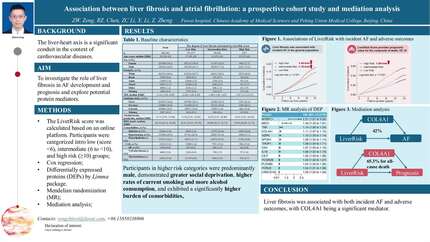
The liver-heart axis is a significant conduit in the context of cardiovascular diseases. However, the relationship between liver fibrosis and the risk of incident atrial fibrillation (AF), as well as clinical outcomes for patients with AF, remains unclear.
To investigate the role of liver fibrosis in AF development and prognosis and explore potential protein mediators.
In the UK Biobank, the LiverRisk score was calculated based on an online platform. Participants were categorized intro low (score <6), intermediate (6 to <10), and high risk (≥10) groups. Cox regression was used to quantify associations of LiverRisk with AF and clinical outcomes (all-cause death, heart failure, and ischemic stroke). Differentially expressed proteins (DEPs) were identified using 2920 Olink protein, whose causal relationship with AF was confirmed by Mendelian randomization (MR). Mediation analysis was performed to identify potential protein mediators.
Among 398,520 participants (median age: 58 years, 54.3% female), 26,700 incident AF cases were documented during a median follow-up of 13.7 years. Higher LiverRisk were associated with an increased incident AF risk (high vs low: adjusted HR [aHR]: 1.45; 95% CI: 1.32-1.60; intermediate vs low: aHR: 1.10; 95% CI: 1.07-1.14). In patients with baseline AF (n = 5714), elevated LiverRisk was significantly associated with the composite outcome (aHR: 1.58; 95% CI: 1.32-1.85). Results remained robust with multiple other fibrosis scores. COL4A1 demonstrated the largest mediation proportion of 42% (95% CI: 18.3%-70.1%) with incident AF and 65.3% (95% CI: 13.1%-95.9%) with all-cause death.
Liver fibrosis was associated with both incident AF and adverse outcomes, with COL4A1 being a significant mediator. Non-invasive liver fibrosis assessment should be implemented in the settings of AF prevention and management.


You may be interested in