Infectious endocarditis after pacemaker implantation in cardiac surgery patients
European Heart Journal


Abstract
Cardiac surgery is associated with a risk of bradyarrhythmias requring the placement of a cardiac implantable electronic device (CIED). The long-term risk of infectious endocarditis in cardiac surgery patients requiring a CIED is unknown.
The study aimed to investigate the risk of developing infectious endocarditis in patients receiving a pacemaker after cardiac surgery.
All patients in Sweden who had cardiac surgery between 2006 and 2020 were identified using the The Swedish Cardiac Surgery Registry. Patients with previous or current endocarditis as indication for surgery were excluded. Data from this registry was merged with the Swedish Pacemaker- and ICD-registry, the National Patient Registry, and the Swedish Total Population Register. These registers contain data on all device placements, all hospital-based diagnoses and mortality in Sweden. Adjusted Cox regression analyses were used to evaluate the risk of infectious endocarditis associated with CIED placement within 30 days after cardiac surgery. The model was adjusted to account for comorbid conditions and type of surgery performed. The risk of mortality associated with endocarditis was also evaluated.
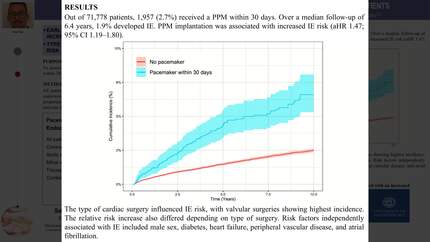
In total 71,778 patients were included in the study. The mean age was 68.0 (SD 10.0) and 25.3% were women. Of these 2.7% (n=1,957) received a pacemaker within 30 days following cardiac surgery. Patients who received a pacemaker were older, had a higher prevalence of heart failure, atrial fibrillation and left ventricular ejection fraction. Over a median follow-up period of 6.5 years (IQR 3.2 – 10.1) 1,368 patients (1.9%) developed endocarditis. CIED placement within 30 days was associated with a significantly higher risk for endocarditis (aHR: 1.51, 95% confidence interval (95% CI) 1.20-1.90, p<0.001) in an adjusted model. Cumulative incidence figures separated clearly during follow-up (Figure 1). A diagnosis of endocarditis was associated with a higher risk of subsequent mortality (HR 1.81, 95% CI 1.68-1.95).
There was a consistent association between the CIED placement and an increased risk of endocarditis. A diagnosis of endocarditis was associated with higher mortality.
Contributors


You may be interested in