Circulating transthyretin with atrial fibrillation risk, and the modifying role of BMI
European Heart Journal


Abstract
Low circulating transthyretin (TTR) concentration has been suggested as a biomarker of transthyretin tetramer instability, a prerequisite for the development of transthyretin cardiac amyloidosis (ATTR). Important clinical manifestations of ATTR include cardiac arrhythmias such as atrial fibrillation (AF). Whether low circulating TTR concentration confers increased risk of incident arrhythmias in the general population is unknown.
To evaluate the associations between circulating TTR levels with incident AF and other cardiac arrhythmias in the general population.
This study used data form the UK Biobank. Participants with available TTR data and without prior arrhythmias were included. The primary outcome was new-onset AF. The secondary outcomes were new-onset supraventricular arrhythmias (SVA), bradyarrhythmias, cardiac block, and ventricular arrhythmias (VA). Multivariable Cox model was applied to evaluate the associations between circulating TTR levels with outcomes, adjusting for demographic characteristics, laboratory measurements, comorbidities, and medication history.
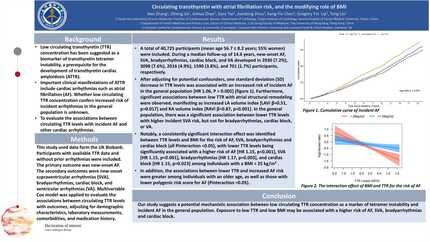
A total of 40,725 participants (mean age 56.7 ± 8.2 years; 55% women) were included. During a median follow-up of 14.6 years, new-onset AF, SVA, bradyarrhythmias, cardiac block, and VA developed in 2930 (7.2%), 3098 (7.6%), 2016 (4.9%), 1590 (3.8%), and 701 (1.7%) participants, respectively. After adjusting for potential confounders, one standard deviation (SD) decrease in TTR levels was associated with an increased risk of incident AF in the general population [HR 1.06, P = 0.005] (Figure 1). Furthermore, significant associations between low TTR with atrial structural remodeling were observed, manifesting as increased LA volume index [LAVi β=0.51, p=0.017] and RA volume index [RAVi β=0.87, p<0.001]. In the general population, there was a significant association between lower TTR levels with higher incident SVA risk, but not for bradyarrhythmias, cardiac block, or VA. Notably, a consistently significant interaction effect was identified between TTR levels and BMI for the risk of AF, SVA, bradyarrhythmias and cardiac block (all Pinteraction <0.05), with lower TTR levels being significantly associated with a higher risk of AF [HR 1.15, p<0.001], SVA [HR 1.15, p<0.001], bradyarrhythmias [HR 1.17, p=0.003], and cardiac block [HR 1.15, p=0.023] among individuals with a BMI < 25 kg/m² (Figure 2). In addition, the associations between lower TTR and increased AF risk were greater among individuals with an older age, as well as those with lower polygenic risk score for AF (Pinteraction <0.05).
Our study suggests a potential mechanistic association between low circulating TTR concentration as a marker of tetramer instability and incident AF in the general population. Exposure to low TTR and low BMI may be associated with a higher risk of AF, SVA, bradyarrhythmias and cardiac block.




You may be interested in