Predictors and impact of major bleeding events in atrial fibrillation patients: a multistate model analysis form two large observational registries
European Heart Journal


Abstract
Understanding the impact of major bleeding events among patients with atrial fibrillation (AF) is important to inform clinicians on the disease trajectories of patients.
We aimed to investigate predictors of major bleeding events and their impact on adverse outcomes using a multistate model analysis.
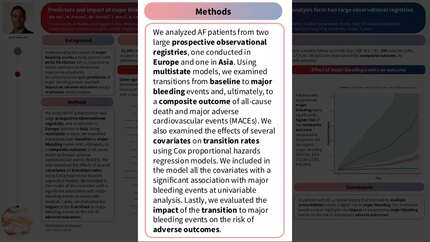
We analysed AF patients from two large prospective observational registries, one conducted in Europe and one in Asia. Using multistate models, we examined transitions from baseline to major bleeding events and, ultimately, to a composite outcome of all-cause death and major adverse cardiovascular events (MACEs). We also examined the effects of several covariates on transition rates using Cox proportional hazards regression models. We included in the model all the covariates with a significant association with major bleeding events at univariable analysis. Lastly, we evaluated the impact of the transition to major bleeding events on the risk of adverse outcomes.
Results 12,360 patients with AF (mean age 68.9, SD 11.6 years; 38.7% female) were included in the analysis. Over a median follow-up of 696 days (IQR 365–735), 204 patients (1.6%, incident rate [IR] 1.06 per 100 person-years [pys]) had major bleeding events, of whom 36 (17.6%, IR 17.4 per 100 pys) later experienced the composite outcome. An additional 1,151 patients (9.3%, IR 5.98 per 100 pys) transitioned directly from baseline to the composite outcome. Older age (≥75 years), low body weight, cardiovascular conditions (heart failure, prior thromboembolism), and non-cardiovascular comorbidities (malignancy, prior bleeding, anaemia) increased the risk of both major bleeding and adverse outcomes (Figure 1). OAC therapy was associated with a lower risk of the composite outcome, both from baseline and after a major bleeding event, without significantly increasing bleeding risk (Figure 1).
Patients who experienced major bleeding had a significantly higher risk of the composite outcome compared to those who did not report major bleeding (HR 9.00, 95% CI 2.90–27.93, P<0.001, Figure 2).
In patients with AF, a clinical history characterised by multiple comorbidities entails a higher risk of major bleeding. Our multistate model analysis highlights the impact of experiencing major bleeding eventson the risk of subsequent adverse outcomes. A holistic integrated approach is needed to reduce the burden of adverse outcomes in patients reporting major bleeding. Forest plots of covariates Cumulative transition rates
Contributors


M Proietti
Author
G F Romiti
Author
T Bucci
Author
B Corica
Author
J F Imberti
Author
M Vitolo
Author
A Shantsila
Author
H F Tse
Author
T F Chao
Author
G Boriani
Author
G Y H Lip
Author
You may be interested in