Genotype-specific differences in short QT syndrome include variations in cardiac event timing and ECG features, with potassium channel blockers holding potential as a therapeutic strategy
European Heart Journal


Abstract
short QT syndrome (SQTS) is an inherited disease characterized by abnormally short QT intervals, which can lead to ventricular fibrillation and sudden cardiac death. The prevalence of SQTS is extremely low. Several causative genes of SQTS have been reported. However, in SQTS, the genotype-phenotype relationships, including pharmacological effects, have not yet been elucidated.
This study aimed to investigate the clinical manifestations, electrocardiographic (ECG) characteristics, and pharmacological effects according to the genotype.
We examined eight patients with SQTS from two families (four patients in each family) with pathogenic variants. We focused on investigating various ECG parameters previously suggested as potential diagnostic and risk-stratification markers for SQTS. ECG parameters include PQ segment depression (PQD), shortened J point-T peak intervals, and early repolarization. We measured several ECG parameters from the precordial lead that showed the highest T-wave amplitude: intervals of RR, QT, J point-T peak (JTp), J point-T end (JTe), T peak-T end (TpTe), and T-wave amplitude. All repolarization interval measurements were corrected for RR intervals using Bazett's formula. We compared ECG measurements and clinical findings between the two families. To evaluate the therapeutic effectiveness of antiarrhythmic drugs, we administered them to some patients and monitored their ECG responses.
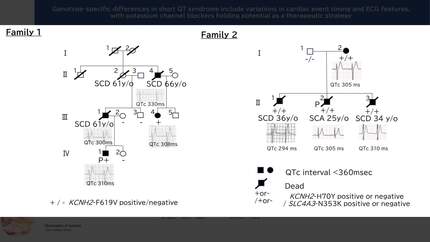
A KCNH2 variant (c.1855T>G, p.F619V) was identified in family 1, while family 2 carried two missense variants, KCNH2 (c.208C>T, p.H70Y) and SLC4A3 (c.1059C>A, p.N353K). Cardiac events varied between the two families. In family 1, two male patients in their 60’s experienced ventricular fibrillation and sudden cardiac death while at work. In contrast, in family 2, cardiac events occurred during sleep at night, affecting individuals in their 20s and 30s. We observed short QT intervals, with the mean QTc being 309.8 ± 12.1 ms in family 1 (KCNH2-F619V) and 313.5 ± 19.1 ms in family 2 (KCNH2-H70Y and SLC4A3-N353K). Although there were no significant differences in QTc (p = 0.783), JTpc [median (IQR): 124.5 (120.0-146.3) vs. 133.0 (125.0-143.0) ms, p = 0.886], JTec [median (IQR): 194.5 (193.8-211.8) vs. 221.5 (216.3-230.3) ms, p = 0.343], and T-wave amplitude (mean: 0.9 ± 0.4 vs. 1.6 ± 0.5 mV, p = 0.08), the TpTec interval in family 1 was significantly shorter than in family 2 (69.5 ± 7.5 vs. 90.0 ± 5.6 ms, p = 0.005). The prevalence rates of ER (25%) and PQD (75%) were identical in the two families. QT prolongation caused by antiarrhythmic drugs with potassium channel-blocking effects was observed in both families after the administration of nifekalant and bepridil.
Clinical manifestations and ECG characteristics of SQTS differed depending on the genotype. Potassium channel blockers may be an effective therapy for patients with SQTS harboring pathogenic variants in SLC4A3 as well as KCNH2.
Contributors

You may be interested in