Evaluating the predictive value of late gadolinium enhancement for major ventricular arrhythmia in phospholamban p.(Arg14del)-positive individuals.
European Heart Journal


Abstract
Late gadolinium enhancement (LGE) on cardiovascular magnetic resonance (CMR) imaging has been associated with an increased risk of sudden cardiac death in patients with non-ischemic cardiomyopathy, particularly in those with the pathogenic phospholamban (PLN) p.(Arg14del) variant. However, the added value of LGE in predicting major ventricular arrhythmias (MVA) in individuals with this genetic variant was unclear, mainly due to limited availability of CMR data in this cohort. With the introduction of a diagnostic and follow-up protocol for PLN p.(Arg14del)-positive individuals, more CMR imaging is performed, enabling more comprehensive analyses.
This study aims to assess the added predictive value of LGE on CMR for major ventricular arrythmia in PLN p.(Arg14del) positive individuals.
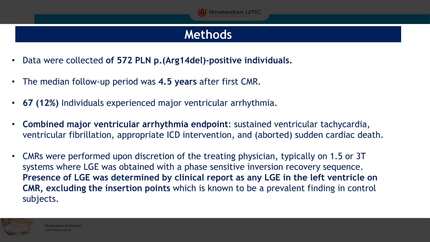
Data were collected from 706 PLN p.(Arg14del)-positive individuals with no history of MVA at baseline, starting from first CMR evaluation until the last follow-up contact, heart transplantation or death from other cause than sudden cardiac death. MVA was defined as sustained VA, appropriate ICD therapy, or (aborted) sudden cardiac death. First, the original predictors from the PLN p.(Arg14del) calculator (left ventricular ejection fraction, premature ventricular contraction count/24 h, amount of negative T waves, and presence of low-voltage electrocardiogram) were reevaluated in this cohort to ensure comparability to the original PLN p.(Arg14del) calculator. Second, LGE on CMR was assessed in univariable and multivariable Cox regression analyses. In multivariable analysis LGE was adjusted for the original predictors from the PLN p.(Arg14del) calculator
During a median follow-up period of 4.5 years [interquartile range (IQR) 1.8-8.1], 61 of 706 (8.6%) PLN p.(Arg14del)-positive individuals experienced MVA, Figure 1 illustrates the cumulative hazard over time. In this cohort, the hazard ratios of the original predictors from the PLN p.(Arg14del) calculator were comparable to those in the original calculator cohort. In univariable analysis, LGE on CMR was significantly associated with MVA (HR 2.90, 95% confidence interval (CI): 1.50-5.62, P-value = 0.002). However, in multivariable analysis adjusting for the predictors from the PLN p.(Arg14del) calculator, LGE was no longer significantly associated with MVA (HR 1.00, 95% CI: 0.45-2.23, P-value 0.993), as shown in Table 1.
LGE on CMR is significantly associated with MVA in PLN p.(Arg14del)-positive individuals. However, it does not provide additional predictive value when incorporated into the PLN p.(Arg14del) calculator. This may be attributed to multicollinearity between LGE and other predictors, such as low-voltage ECG, likely due to the shared underlying mechanism of fibrosis. In other genetic cardiomyopathies, where fibrosis may play a role in MVA prediction, LGE could offer additional value when not already reflected into other predictive variables. Kaplan-Meier plot. Cox regression analyses.
Contributors


T E Verstraelen
Author
R A De Brouwer
Author
E Van Drie
Author
A C Houweling
Author
C Dickhoff
Author
T Germans
Author
B A Schoonderwoerd
Author
L M G Meems
Author
A S J M Te Riele
Author
K Y Van Spaendonck-Zwarts
Author
M G P J Cox
Author
A S Amin
Author
J P Van Tintelen
Author
A A M Wilde
Author
You may be interested in