Genetic factors in risk stratification of concealed long QT patients with no history of beta-blocker use
European Heart Journal


Abstract
Patients with concealed long QT syndrome (LQTS), defined as normal QTc values in carriers of LQTS-associated genetic variants, represent a growing group due to the wide use of genetic family screening. An efficient risk stratification approach for this group is currently lacking.
To explore genetic factors associated with arrhythmic events in patients with concealed LQTS not treated with β-blockers.
509 carriers of pathogenic or likely pathogenic variants in KCNQ1 and KCNH2 (LQT1 and LQT2, respectively), with no history of β-blocker intake before cardiac events or end of follow-up ("β-blocker naïve"), were recruited from seven cardiogenetic clinics in Sweden, Norway and Denmark. Concealed LQTS was defined as QTcB <460 ms in men and <470 ms in women at the first ECG recorded at the age of 16 years or older. The control group was comprised of 1,301 genotype and phenotype negative family members (56% female) to LQTS patients. The impact of sex, LQTS type, and variant type on the risk of cardiac events (CE) was assessed using Kaplan-Meier (KM) and Cox regression. High-risk genetic variants were defined as missense mutations in membrane-spanning/C-loops domains in KCNQ1 and pore domain mutations in KCNH2 genes. CE was defined as either syncope or ventricular arrhythmias (VA; defined as torsades de pointes, appropriate ICD therapy, aborted cardiac arrest, or sudden cardiac death).
1) In total, 130 β-blocker naïve concealed LQTS patients were included (59% female, 22% probands, 68% LQT1). 2) CE by the age of 40 years were reported in 46 (35%) of patients and 170 (13%) of controls. Among those, verified VA was registered in 2 patients (both KCNH2 pore mutation carriers) and 4 controls. Due to the low number of VA, they were not used as a separate end point in further analysis. 3) Female sex was associated with worse CE-free survival, whereas male sex was not associated with increased risk compared to controls (HR female 3.8 (2.6-5.4), p<0.001; HR male 1.4, (0.7-2.6), p=0.353; Figure 1). 4) Both LQT1 and LQT2 were associated with worse CE-free survival compared to controls (LQT1: HRadj 2.1, (1.4-3.2), p<0.001; LQT2: HRadj 4.1, (2.6-6.5), p<0.001). 5) High risk variants of KCNQ1 were associated with worse CE free survival (HR adj 6.7 (3.4-13.2) p<0.001), whereas survival rates of other variant carriers did not differ from the control group (HR adj 1.4 (0.8-2.4) p=0.247, Figure 2). 6) For KCNH2, no significant difference between high and low-risk variants was observed with regards to CE free survival.
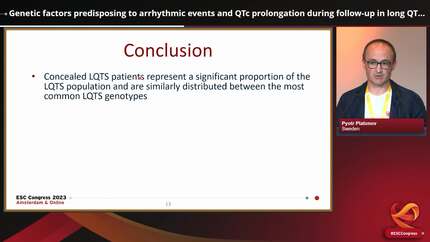
Among β-blocker naïve patients with concealed LQTS phenotype, males and carriers of non-high-risk KCNQ1 gene-variants can be identified as a group of low CE risk. Despite the observational study design, our data provides a rationale for individualized approach with regard to initiation of β-blocker therapy to concealed LQTS patients.
Contributors


A Christensen
Author
C Bugge
Author
I Haby
Author
A Svensson
Author
T O Kock
Author
T Gardovic
Author
C Lundin
Author
N Larsson
Author
A Rydberg
Author
W Zareba
Author
H Bungaard
Author
K Haugaa
Author
P Platonov
Author
You may be interested in