New genetic risk factor for serious cardiac events in Andersen-Tawil Syndrome - p.Arg71Gln variant in BAG3
European Heart Journal


Abstract
Andersen-Tawil syndrome (ATS) is an ultrarare channelopathy caused by pathogenic variants in the KCNJ2. It presents with the typical triad of symptoms – U-wave in the ECG and ventricular arrhythmias, periodic paralysis, and dysmorphic features. Cardiac risk assessment in ATS is difficult due to the heterogeneity clinical manifestation. Some studies showed that polymorphisms in other genes could influence the course of ATS as well as in other LQT syndromes.
The aim of this research was to identify polymorphisms in other genes associated with cardiovascular diseases, which could increase the risk of serious cardiac events in ATS.
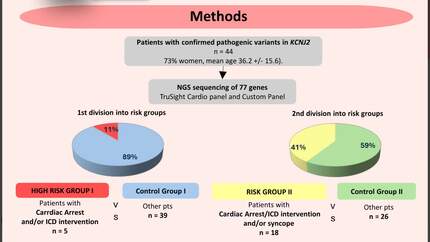
This study consisted of 44 cases with confirmed pathogenic variants in KCNJ2 (73% women, mean age 36.2 +/- 15.6). The TruSight Cardio panel and custom panel were used. Coding regions of the genes together with flanking sequences were sequenced. Variants located within 77 genes present in both panels were qualified for further analyses. Two risk groups were distinguished. The highest risk (called Group I) group included 5 patients with a history of cardiac arrest (CA) or adequate ICD intervention. The high risk group (called Group II) included 18 patients with the above events or with syncope. They were compared with the remaining patients who were included in the control groups (respectively - Control Group I and II). Fisher's test was used for statistical analysis of the results. The Bootstrap method with correction for multiple comparisons was performed to assess the reliability of the obtained data.
In genetic testing 2143 variants were detected, including 274 missense type variants. The statistical analysis revealed 57 variants (incl. 9 missense variants) for Group I and 37 variants (incl. 2 missense variants) for Group II (p < 0.05 for both groups). The highest statistical significance was achieved for a variant NM_004281.4: c.212G>A (p.Arg71Gln) in BAG3 – p = 0.0005 for Group I and p = 0.0026 for Group II. This variant was the only one that retained statistical significance after the Bootstrap analysis for missense type variants. Additionally, the occurrence of the BAG3 variant in Group I was compared to the Control group II - the group with the lowest risk (received p = 0.0002). In this comparison, statistical significance was retained even after the Bootstrap analysis for all variants. The next step was to assess the trend (using the Cochran-Armitage Trend test) for occurrence of this variant in the subsequent groups with a variable degree of risk (showed in Figure). In this analysis p < 0.0001 was obtained. The significance was retained after the Bootstrap analysis, considering all variants.
New generation sequencing could be useful in cardiac risk assessment in ATS. We showed that variant in BAG3 - p.Arg71Gln is the genetic risk factor for serious cardiac events in ATS. It could be helpful in making decisions about treatment of patients with this channelopathy.
Contributors

J Poninska
Author
I Kowalik
Author
P Bienias
Author
R Gajda
Author
A Glowniak
Author
K Mizia-Stec
Author

P Stawinski
Author
E K Biernacka
Author
You may be interested in