The impact of atrial fibrillation progression on the epicardial adipose tissue volume: supporting 'AF begets EAT' theory
European Heart Journal


Abstract
Growing evidence suggests that epicardial adipose tissue (EAT) contributes to the onset and severity of atrial fibrillation (AF), forming the basis of the "EAT begets AF" theory. The underlying mechanisms are likely multifactorial, involving adipocyte-secreted cytokines, oxidative stress, and fatty infiltration, all promoting atrial remodeling. However, whether "AF begets EAT" remains unclear. While a meta-analysis with a limited sample size suggested a positive association between epicardial adipose tissue volume (EATV) and AF progression, it did not elucidate the relationships between EATV, AF burden, and factors related to visceral fat.
This study aimed to investigate the relationship between EATV and AF progression.
We retrospectively analysed consecutive patients with paroxysmal AF (PAF; AF lasting <7 days with spontaneous reversion to sinus rhythm), early-persistent AF (early-PerAF; AF lasting ≥7 days but <6 months), persistent AF (PerAF; AF lasting ≥6 months but <2 years), and longstanding-persistent AF (LS-PerAF; AF persisting ≥2 years) who were treated at our institute between October 2014 and September 2023.
EATV was quantified using a three-dimensional imaging workstation from contrast-enhanced computed tomography images, measuring both Total-EATV (EATV surrounding the entire heart) and LA-EATV (EATV surrounding the left atrium). Baseline characteristics included age, sex, body mass index (BMI), low-density lipoprotein cholesterol, high-density lipoprotein cholesterol (HDL-C), triglyceride, serum uric acid, HbA1c, alcohol consumption, and AF type (model 1) or AF duration (model 2). Significant correlates of EATV were identified using multiple regression analysis.
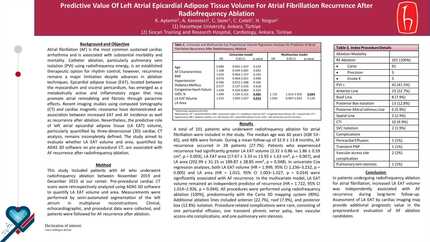
A total of 1,321 patients (mean age: 69.0±9.9 years, 69.7% male) were analysed, including PAF (n=721), early-PerAF (n=266), PerAF (n=239), and LS-PerAF (n=95) groups. Compared to the PAF group, non-PAF patients exhibited significantly larger EATVs [Total-EATV: 152.3 mL (111.4–205.6) vs. 125.9 mL (99.2–160.4), p<0.001; LA-EATV: 47.5 mL (29.9–67.5) vs. 36.4 mL (22.4–48.2), p<0.001] (Figure 1A, B).
Total-EATV and LA-EATV increased proportionally with AF burden in the PAF group (p=0.005 and p<0.001, respectively) (Figure 1C, D). In the non-PAF group, LA-EATV showed a significant increase with AF burden (p=0.02), while the increase in Total-EATV did not reach statistical significance (p=0.16) (Figure 1E, F).
Multiple regression analyses identified AF type and AF duration as significant factors associated with both Total- and LA-EATV, along with age, BMI, HDL-C, and HbA1c (Figure 2A, B).
AF progression is associated with an increase in EATV, supporting the "AF begets EAT" theory. These findings highlight the potential benefits of early intervention in AF patients to interrupt the vicious circle between EAT and AF progression. Graphical abstract & representative case Tables of multiple regression analysis
Contributors

I Morishima
Author
Y Morita
Author
Y Kanzaki
Author
N Watanabe
Author
N Yoshioka
Author
N Shibata
Author
Y Arao
Author
T Oi
Author
H Karasawa
Author
Y Nakagawa
Author
Y Kawasaki
Author
T Yoshie
Author
You may be interested in