Increased rate of MRI-conditional CIEDs following replacement: a single-centre experience
European Heart Journal


Abstract
Magnetic resonance imaging (MRI) is a valuable diagnostic tool across all medical fields with an increased use in daily clinical practice. This trend is critical considering the increasing number of people with Cardiovascular Implantable Electronic Devices (CIEDs), resulting in a significant proportion of CIED patients requiring MRI during their lifetime. While previously considered contraindicated due to potential life-threatening interactions, MRI-conditional devices have been recently introduced in order to safely perform MRI even in CIED patients, provided specific conditions are met. This study explores the increased rate of MRI-conditional CIEDs following device replacement in a single-centre cohort.
To ensure MRI compatibility at the time of device replacement in a single-centre cohort.
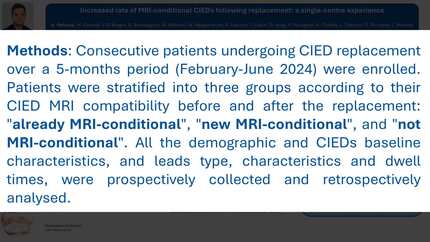
Consecutive patients undergoing CIED replacement over a 5-months period (February-June 2024) were enrolled. Patients were stratified into three groups according to their CIED MRI compatibility before and after the replacement: "already MRI-conditional", "new MRI-conditional", and "not MRI-conditional". All the demographic and CIEDs baseline characteristics, and leads type, characteristics and dwell times, were prospectively collected and retrospectively analysed.
A total of 122 consecutive patients (83M; mean age 77,0 years) undergoing CIEDs replacement were enrolled: 81 pacemakers (3 single-chamber, 75 dual-chamber, and 3 CRT-P) and 41 defibrillators (6 single-chamber, 14 dual-chamber, and 21 CRT-D) (Graphical abstract). Among these, 43 systems were classified as "already MRI-conditional". At the time of replacement, up to 53% of the initially non-MRI-conditional systems (42 out of 79) gained MRI compatibility, becoming "new MRI-conditional" systems, while the remaining 47% (37 out of 79) remained "not MRI-conditional" (Graphical abstract). The main reasons of MRI incompatibility included the presence of not MRI-conditional leads (n = 24), leads from different brands (n = 16), abandoned leads (n = 8), or epicardial leads (n = 3) (Figure 2). However, following generator replacement, only 30% (37 out of 122) remained as "not MRI-conditional", exhibiting a significantly longer leads dwell time (median 14,6 vs 11,0 and 9,1 years; p < 0,001) (Graphical abstract).
In our study more than 50% of previously non-MRI conditional systems acquired MRI compatibility after CIED replacement. Only a small proportion (30%) of CIEDs remained as "not MRI-conditional", due to presence of not MRI-conditional leads (n = 24), leads from different brands (n = 16), abandoned leads (n = 8), or epicardial leads (n = 3). These results underscore that, at the time of CIED replacement, the rate of MRI compatibility can be significantly increased, ensuring broader access to essential MRI diagnostics to a wider population of patients with CIEDs. Graphical abstract Features of "not MRI-conditional" group
Contributors


M Fusaroli
Author
M Beltrami
Author
N Mangiaracina
Author
F Casucci
Author
I Casini
Author
D Jazaj
Author
A Colella
Author
G Ricciardi
Author

You may be interested in