Temporal trends in utilization of transvenous lead extraction among patients with cardiac implantable electrical device infection
European Heart Journal


Abstract
The authors sought to investigate the reliable number of patients presenting with cardiac implantable electronic device (CIED) infection, the rate of guideline-directed therapy for CIED infection, and those annual trends.
CIED related procedures have increased with an aging population and increasing cardiovascular disease complexity. However, the rate of CIED-related infections and utilization of guideline-directed transvenous lead extraction (TLE) for infection are unknown.
This survey used data from the Japanese Registry of All Cardiac and Vascular Diseases – Diagnosis Procedure Combination (JROAD-DPC), a nationwide claim database, which includes the claims database covering >60% of all cardiovascular training hospitals in Japan. It contains patient demographics and disease-specific data for each patient. Based on the DPC database, the JROAD-DPC database was created by combining JROAD data derived from a Japanese Circulation Society national survey. From 2015 to 2021, CIED related admissions were analyzed. Among these admissions, the ICD-10-CM codes corresponding to CIED infection including pocket infection, infective endocarditis, endocarditis, bacteremia, or fungemia were identified. Patients with ICD-code of infection and anti-biotic administration >3 days were identified as the CIED infection. Among CIED related infection, the proportion of TLE utilization and its annual trend were analyzed.
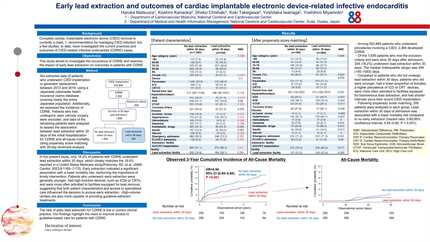
The number of CIED related procedure increased annually totaling 318,915 from 2015 to 2021, however the rate of CIED related infection decreased (Figure A). Among 4,625 CIEDs related infections (1,393 females and 3,232 males), 47.2% (n=2,184) were treated with TLE throughout the study periods. The proportion undergoing TLE increased from 39.6% in 2015 to 56.3% in 2021 (Figure B). Females were less likely to undergo TLE compared with males (44.6% vs 54.5%, p<0.001). TLE procedure was less likely to be performed with older age (79 [72-86] vs 77 [69-83], p<0.001) and lower body mass index (22.1 [19.5-24.7] vs 22.4 [20.1-24.9], p=0.006). Patients with comorbidities, such as congestive heart failure (49.7% vs 52.7%, p=0.043), diabetes mellites (48.4% vs 52.3%, p=0.025), cardiovascular disease (32.7% vs 52.8%, p<0.001), and cancer (38.5 % vs 51.9%, p=0.002), were also less likely to be treated with TLE. Hospitals with more than 300 beds were associated with higher TLE utilization (53.3% vs 38.1%, p<0.001).
The rate of CIED related infection did not increase despite the increasing CIED procedures. The proportion utilizing guideline-directed TLE increased annually, however, it was less than two-thirds even in most recent analysis year of 2021. Older age, female sex, presence of comorbidities, and lower hospital bed volume were associated with lower utilization of TLE.
Contributors

You may be interested in