Analysis on etiology and progression of CIED-related tricuspid valve regurgitation at medium-term follow-up: untangling the tricuspid valve with 3DTTE
European Heart Journal


Abstract
The implantation of cardiac implantable electronic devices (CIEDs) has become a cornerstone in the management of patients with bradyarrhythmia, tachyarrhythmia, and sudden cardiac death prevention. However, CIED-related tricuspid regurgitation (TR) has emerged as a significant complication, with potential implications for right ventricular function and clinical outcomes. While previous studies have reported varying prevalence rates, the exact mechanisms and predictive factors for TR progression remain incompletely understood.
This study aims to evaluate the incidence and progression of TR following right ventricular lead implantation, distinguish between CIED-related and CIED-associated TR, and assess the relationship between lead position and TR severity using three-dimensional transthoracic echocardiography (3D TTE).
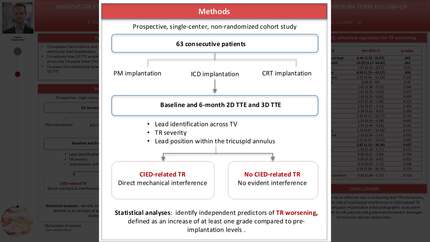
This prospective, single-center, non-randomized cohort study included 63 consecutive patients who underwent pacemaker (PM), implantable cardioverter-defibrillator (ICD), or cardiac resynchronization therapy (CRT) implantation between January and June 2024. All patients underwent baseline and 6-month follow-up assessments with two-dimensional (2D TTE) and 3D TTE. TR severity was graded based on echocardiographic parameters, and lead position within the tricuspid annulus (TA) was analyzed. Patients were categorized into CIED-related TR (with direct mechanical interference) and CIED-associated TR (without evident interference). Statistical analyses included comparative and regression models to identify independent predictors of TR progression.
At baseline, 25 (39.7%) patients had trace TR, 28 (44.4%) had mild TR, 9 (14.3%) had moderate TR, and 1 (1.6%) had severe TR. At follow-up, TR progression was observed in 12 patients (19%), with 20.6% classified as CIED-related TR. 3D TTE successfully identified lead positions in 92.1% of cases, revealing that non-commissural lead placement was significantly associated with TR worsening (p < 0.005). Septal leaflet impingement and posterior leaflet adherence were identified as independent risk factors for TR progression (p = 0.006 and p = 0.003, respectively). No significant differences in heart failure hospitalizations were observed between groups within the 6-month follow-up period.
3D TTE proved to be an effective tool in evaluating lead-TR interactions, highlighting the role of mechanical interference in CIED-related TR progression. Early post-implantation echocardiographic assessment may help identify at-risk patients and guide lead placement strategies to minimize valvular dysfunction. Further studies with longer follow-up and larger cohorts are needed to better understand the long-term clinical impact of CIED-related TR.
Contributors


V Barletta
Author
L Michelotti
Author
M Parollo
Author
A Canu
Author
M Giannotti Santoro
Author
S Sbragi
Author
A Di Cori
Author
L Segreti
Author
R De Lucia
Author
G Zucchelli
Author
You may be interested in