Long term real world performance of the micra leadless pacemaker: a single-center study
European Heart Journal


Abstract
Leadless pacemakers have demonstrated safety and efficacy with fewer complications compared to conventional pacemakers. However, data on their long-term performance remain limited. This study aimed to evaluate the long-term efficiency and durability of Micra leadless pacemakers over a nine-year follow-up period.
Single-center, retrospective study of patients with Micra implanted between August 2015 and April 2024. Follow-up was conducted via remote monitoring (RM), with scheduled transmissions every 6 months. Baseline characteristics and electrical performance were recorded at implantation, first and last transmission. Battery longevity was projected using the "Micra VR and AV Longevity Models", incorporating patient-specific data, capacity, and current drain. Early depletion was defined as a decrease of more than 80% of the manufacturer’s estimated lifespan.
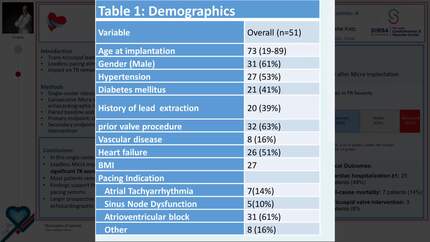
A total of 459 Micra were implanted, with 244 patients followed through remote monitoring (RM) (72.5% VR, 27.5% AV). The mean age at implantation was 84.4 ± 7.6 years, with a median follow-up of 26 ± 21.3 months. Electrical parameters remained stable over time (Figure 1). In the estimated projection analysis, 97% of patients maintained optimal battery performance, while only 3% (7 patients) exhibited reduced battery life due to high thresholds (> 2.0 V at 0.24 ms). Early battery depletion was observed within the first three years only in patients wiht high output. From the fourth year onward, all evaluated patients sustained optimal battery performance, confirming the device's long-term reliability and durability (Figure 2).
The Micra leadless pacemaker demonstrates appropriate long-term performance, with stable pacing parameters and battery durability. These results supporting its value in real-world clinical practice. Device electrical performance Device remaining longevity
Contributors


L Azocar Alcala
Author
J Quispe Santos
Author
B Campos Garcia
Author
E Rodriguez Font
Author
J Guerra Ramos
Author
C Alonso Martin
Author
Z Moreno Weidmann
Author
E Gilces Bravo
Author
D Majo Ramirez
Author
M Grande Osorio
Author
I Ramirez De Diego
Author
L Sanchez Martin
Author
X Vinolas Prat
Author
You may be interested in