Mid-term results of combining left bundle branch area pacing with cardiac resynchronization therapy in heart failure patients: a better choice?
European Heart Journal


Abstract
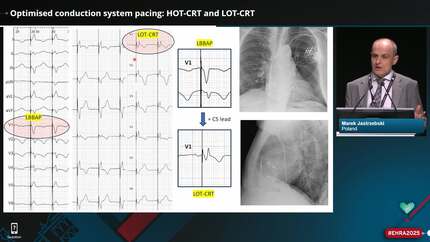
About one-third of candidates who received cardiac resynchronization therapy (CRT) remained to be non-responders. Based on the findings that left bundle branch area pacing provided more physiological electrical activation than right ventricular pacing, it was interesting to know whether left bundle branch–optimized CRT (LOT-CRT) would show a better result over conventional biventricular CRT (BiV-CRT).
This prospective cohort study was designed to compare the efficacy of LOT-CRT versus classical BiV-CRT in CRT candidates.
70 patients (66±9 years, 68.6% male) who fulfilled the criteria of CRT implantation were assigned to receive LOT-CRT (n=30) or BiV-CRT (n=40) according to implantation cardiologists’ decisions. Those with atrial fibrillation or flutter (AF) were all given LOT-CRT. Electrical and mechanical synchronicity, left ventricular (LV) structure function were assessed before implantation and after 6 months. The measured parameters included QRS duration (QRSd), interventricular mechanical delay (IVMD), as well as peak strain dispersion (PSD), LV diameter and volume namely left ventricular end-diastolic diameter (LVEDD), left ventricular end-diastolic volume (LVEDV) and left ventricular end-systolic volume (LVESV), and LV global longitudinal strain (GLS) and myocardial work (MW) using two-dimensional speckle-tracking echocardiography, which consisted of global work index (GWI), global constructive work (GCW), global wasted work (GWW), and global work efficiency (GWE).
Baseline clinical characteristics were comparable between the two groups except that there were 13 (43.3%) patients with AF in the LOT-CRT. During 6-month follow-up, the LOT-CRT group had a more profound reduction in QRSd (42.0[23.3, 74.5] vs. 17.0[16.3, 23.8], P<0.001) and PSD (72.0[43.0, 114.3] vs. 35.5[4.3, 82.0], p=0.001) but not IVMD (29.0[21.8, 36.8] vs. 34.5[21.3, 46.0], P=0.626). Both groups exhibited similarly significant improvement in LV structure, ejection fraction (EF), GLS and MW after implantation (Table 1), except that the LOT-CRT group displayed a better increase in GWE (24.0[11.0,29.3] vs. 10.0[6.3,14.8], P<0.001). Subgroup analysis demonstrated a consistent favorable effect of LOT-CRT in patients with AF on reducing LV dyssynchrony along with recovering LV structure and function (brackets in Table 1).
LOT-CRT displayed a greater degree of electrical and mechanical resynchronization compared to BiV-CRT at mid-term follow-up. However, further studies with longer follow-up are warranted to investigate whether it will be translated into LV remodeling and outcome benefits.


You may be interested in