Time to notch versus traditional left bundle branch block criteria for cardiac resynchronisation therapy patient selection
European Heart Journal


Abstract
About one-third of cardiac resynchronization therapy (CRT) recipients are considered non-responders. CRT is associated with greater benefit in patients with true left bundle branch block (LBBB) compared to intraventricular conduction delay (IVCD). A new ECG criterion for true LBBB, the Time to Notch in Lead I (TTN) >75 ms, based intracardiac recordings, was proposed to accurately distinguish LBBB and IVCD.
To investigate changes in left ventricular ejection fraction (LVEF) after CRT implantation among patients presenting TTN greater than 75 ms in comparison with established LBBB diagnostic criteria.
We retrospectively analysed ECG tracings from 158 patients who underwent CRT-P or CRT-D implantation or upgrade between January 2015 and January 2024 at our tertiary institution. We excluded implantations as part of a pace and ablate strategy. For each patient we measured TTN and assessed the presence of LBBB diagnostic criteria (AHA 2018, ESC 2021, Strauss) in baseline 12-lead ECGs. LVEF was assessed pre and post implantation. CRT echocardiographic response was defined as an increase of at least 5% in LVEF after CRT implantation.
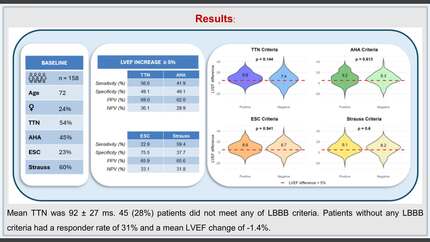
Overall, median age was 72 (IQR 65-81) years, and 38 (24%) patients were female. At the time of implantation, 154 (98%) patients had a history of heart failure, 129 (82%) arterial hypertension and 58 (37%) had previous myocardial infarction. Mean LVEF preimplantation was 30.2±9.4 %. In the baseline ECG, 71 patients (45%) met the diagnostic AHA criteria, 37 (23%) the ESC criteria and 95 (60%) the Strauss criteria. TTN greater than 75 ms was present in 86 (54%) patients with a mean TTN of 92.1±27.1 ms. 45 (28%) patients did not meet any of LBBB criteria.
The responder rates were 69%, 62%, 65%, and 65% for TTN >75 ms, and for the positive AHA, ESC, and Strauss criteria, respectively. Mean LVEF changes after CRT implantation were +9.8%, +9.2%, +8.8% and +9.1% in patients with TTN >75 ms, positive AHA, ESC and Strauss criteria, respectively (Figure, right panel). We found a numerically higher change in LVEF in the TTN >75 ms group compared to the TTN ≤75 ms group. Patients without any LBBB criteria had a responder rate of 31% and a LVEF change of -1.4%. Estimates for sensitivity, specificity, positive and negative predictive value of each criterion for CRT response are shown in the left panel of the Figure.
The TTN criterion might be useful to identify patients with a favourable CRT response in comparison to other LBBB criteria. Larger studies are needed to validate our findings. Main results of the study.
Contributors


S Stempfel
Author
B Voegeli
Author
B Subin
Author
J Pouly
Author
M Mutti
Author
D Spreen
Author
S Knecht
Author
B Schaer
Author
N Schaerli
Author
P Badertscher
Author
F Mahfoud
Author
M Kuehne
Author
C Sticherling
Author
P Krisai
Author
You may be interested in