Impact of changes in QRS fragmentation with cardiac resynchronisation therapy: differences between ischaemic and non-ischaemic aetiologies
European Heart Journal


Abstract
Cardiac resynchronisation therapy (CRT) is recommended in patients with symptomatic heart failure, left ventricular ejection fraction (LVEF) ≤35% and a wide QRS complex ≥130 ms despite optimal medical treatment; in order to improve symptoms and reduce morbidity and mortality. Fragmented QRS (fQRS) implies the presence of myocardial fibrosis. It is associated with an increased risk of mortality, major adverse cardiac events and ventricular arrhythmias; both in patients with ischaemic cardiomyopathy (ICM) and non-ischaemic cardiomyopathy (nICM) such as dilated or hypertrophic cardiomyopathies. However, fQRS role in patients undergoing CRT, particularly in relation to the aetiology of cardiac disease, remains unclear.
To assess the prognostic value of fQRS and its changes before and after CRT in terms of all-cause mortality, according to the aetiology of the underlying cardiomyopathy.
An observational retrospective study was performed. Patients who underwent CRT between 2009 and 2022 in a tertiary hospital, categorised according to the presence of ICM or nICM, were included. fQRS before and after CRT was defined based on different patterns of RSR', additional R waves (R′), and notches in the R and S waves in two contiguous leads. Patients were classified into four categories based on the presence or absence of fQRS before and after device implantation.
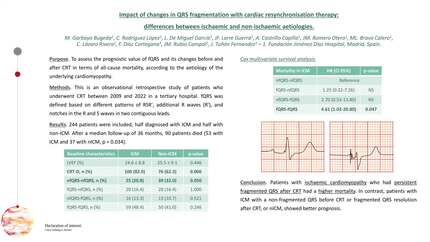
A total of 244 patients were included, half diagnosed with ICM and half with nICM. In the ICM group, the median age was 73.6±8.0 years, 92.6% were men, 70.8% had synus rhythm (SR) and 80.7% had left bundle branch block (LBBB), and the median LVEF was 24.6±4.8. In contrast, in the nICM group, the median age was 70.3±11.2 years, 42.3% were men, 37.1% had SR and 82.8% had LBBB, and the median LVEF was 25.5±9.1 (Table 1). After a median follow-up of 36 months, 90 patients died (53 with ICM and 37 with nICM, p = 0.034). A Cox multivariate survival analysis stratified by cardiomyopathy type was conducted. Persistent fQRS before and after CRT was associated with increased mortality in patients with ICM (HR 4.61 (1.02–20.80)). Resolution or new onset of fQRS after CRT in ICM was not significantly associated with increased mortality. Furthermore, there was no difference in mortality in patients with nICM (Table 2).
Patients with ICM who had persistent fQRS after CRT had a higher mortality. In contrast, patients with ICM with a non-fragmented QRS before CRT or fQRS resolution after CRT, or nICM, showed better prognosis. Baseline characteristics. Cox Regression.
Contributors

C Rodriguez Lopez
Author
L De Miguel Garcia
Author
J F Larre Guerra
Author
A Castrillo Capilla
Author
J M Romero Otero
Author
M L Bravo Calero
Author
C Lazaro Rivera
Author
F Diaz Cortegana
Author

J Tunon Fernandez
Author
You may be interested in