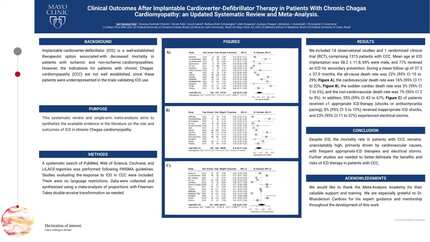
Clinical outcomes after implantable cardioverter-defibrillator therapy in patients with chronic Chagas cardiomyopathy: an updated systematic review and meta-analysis
European Heart Journal


Abstract
Implantable cardioverter-defibrillator (ICD) is a well-established therapeutic option associated with decreased mortality in patients with ischemic and non-ischemic cardiomyopathies. However, the indications for patients with chronic Chagas cardiomyopathy (CCC) are not well established since these patients were underrepresented in the trials validating ICD use.
This systematic review and single-arm meta-analysis aims to synthetize the available evidence in the literature on the role and outcomes of ICD in CCC.
A systematic search of PubMed, Web of Science, Cochrane, and LILACS registries was performed following PRISMA guidelines. Studies evaluating the response to ICD in CCC were included. There were no language restrictions. Data were collected and synthesized using a meta-analysis of proportions with Freeman-Tukey double-arcsine transformation as needed.
We included 14 observational studies and 1 randomized clinical trial (RCT), comprising 1315 patients with CCC. Mean age at ICD implantation was 58.2 ± 11.8, 65% were male, and 77% received an ICD for secondary prevention. During a mean follow up of 37.3 ± 37.0 months, the all-cause death rate was 22% (95% CI 15 to 29%; Figure 1A), the cardiovascular death rate was 16% (95% CI 11 to 22%; Figure 1B), the sudden cardiac death rate was 3% (95% CI 2 to 5%), and the non-cardiovascular death rate was 7% (95% CI 2 to 5%). In addition, 55% (95% CI 43 to 67%; Figure 1C) of patients received ≥1 appropriate ICD therapy (shocks or antitachycardia pacing), 8% (95% CI 5 to 12%) received inappropriate ICD shocks, and 23% (95% CI 11 to 37%) experienced electrical storms.
Despite ICD, the mortality rate in patients with CCC remains unacceptably high, primarily driven by cardiovascular causes, with frequent appropriate ICD therapies and electrical storms. Further studies are needed to better delineate the benefits and risks of ICD therapy in patients with CCC.
Contributors


You may be interested in