Head-to-head comparison of single- versus dual-chamber ICD discriminators for tachyarrhythmia detection: a remote monitoring based, bicentric study
European Heart Journal


Abstract
Modern implantable cardioverter-defibrillators (ICDs) utilize single-chamber (SC) or dual-chamber (DC) discrimination algorithms to differentiate between tachyarrhythmias and minimize the risk of inappropriate therapies. While modern SC algorithms, especially those with morphology detection, are considered comparable to DC algorithms, the available data are limited.
We aimed to compare the efficacy of SC and DC discrimination algorithms in malignant tachyarrhythmias using remote monitoring data.
Data from all patients who were under follow-up until 2024 at two tertiary referral centers and had ICDs implanted from a single manufacturer, which were remotely monitored using the Home Monitoring system, were retrospectively analyzed. Patients were divided into SC and DC groups based on the programmed discrimination algorithm. The primary outcome was the risk of inappropriate therapies comparing SC vs. DC discriminators. A sensitivity analysis was also performed, including only a subgroup of SC patients with active morphology discrimination.
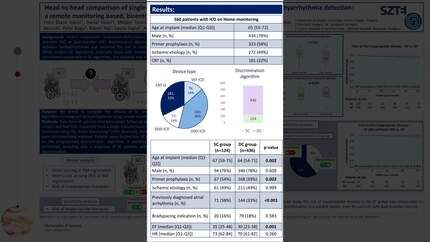
A total of 560 patients were included (mean age 63±13, male 78%, primary prophylaxis 58%). The distribution of the implanted ICDs was as follows: 76 VVI, 226 VDD, 77 DDD and 181 CRT-D devices. 124 ICDs were programmed to utilize SC and 436 to apply DC discriminators. Among the SC group, 47 (39%) ICDs used active morphology discrimination. During the mean follow-up of 2.9 years the incidence of inappropriate ICD therapies was 3.2% in the SC and 4.8% in the DC group, with no significant difference observed between the two groups (Hazard Ratio [HR] 1.304; 95% Confidence Interval [CI] 0.445-3.822; p=0.628). Furthermore, the predefined sensitivity analysis did not reveal any significant difference regarding this parameter (2.1% vs. 4.8%, HR 2.023; 95% CI 0.271-15.100; p=0.492).
In our bicentric, remote monitoring-based study, the risk of inappropriate therapy in the SC group was comparable to the DC group. Based on our results, SC discrimination is a suitable option, even for patients with dual-chamber devices. Graphical abstract

You may be interested in