Predictors of ICD therapy in cardiac sarcoidosis patients within large metropolitan population
European Heart Journal


Abstract
Cardiac sarcoidosis (CS) is an inflammatory cardiomyopathy that manifests as heart failure and fatal arrhythmia, resulting in increased risk of sudden cardiac death. Implantable cardioverter-defibrillator (ICD) therapy plays a vital role in correcting life-threatening ventricular arrhythmias in these patients. However, there is currently no standardized ICD therapy guidelines for primary prevention in CS. In a recent study based on the Netherlands population, independent predictors of ICD therapy in patients with CS were identified.
This study aims to identify predictors of appropriate ICD therapy in a large heterogeneous metropolitan population and to compare these to the predictors in the Netherlands study, which had a homogenous population, in an effort to refine the indications for ICD implantation in those with CS.
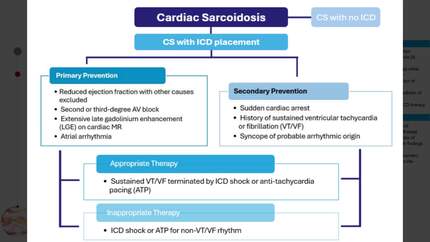
A single-center retrospective study of patients was performed on patients with ICD implantation after CS diagnosis. ICD implant was classified as primary or secondary prevention. Primary prevention (PP) indications were a reduced ejection fraction with other causes excluded, second or third-degree AV block, extensive late gadolinium enhancement (LGE) on CMR, or atrial arrhythmia. Secondary prevention (SP) indications included sudden cardiac arrest, history of sustained ventricular tachycardia/fibrillation (VT/VF), or syncope of probable arrhythmic origin. Primary outcome was appropriate ICD therapy. Appropriate ICD therapy included sustained VT/VF terminated by shock or ATP. Secondary outcome parameters included inappropriate ICD therapy. Inappropriate ICD therapy included shock or ATP delivered for any rhythm outside of VT/VF. Statistical analysis was performed using RStudio.
Among 94 patients with clinically diagnosed cardiac sarcoidosis, 66 patients received an ICD. Of these, 41 patients received ICD implant as PP (62.1%), of which 13 patients received appropriate therapy at least once (31.7%). Of the 25 SP patients, 10 patients received appropriate therapy (40.0%). LGE of right ventricle was identified as the only predictor of appropriate shock therapy (p = 0.049). Obesity with BMI > 30 was identified as a predictor of appropriate ATP therapy (p = 0.048). 4 patients were identified with inappropriate ICD therapy secondary to atrial fibrillation or supraventricular tachycardia, where 3 of them belonged to PP. No statistically significant predictors were identified for inappropriate ICD therapy.
LGE of right ventricle was identified as a predictor of appropriate ICD therapy, which was more common in SP patients. These findings were similar to those seen in the homogenous Netherlands population. The findings of our study emphasize the need for further evaluation of the ICD indications in CS. Further exploration of additional factors could refine patient selection and optimize prevention strategies for life-threatening arrhythmias in CS patients.
Contributors

A Correa
Author
N Kim
Author
Mount Sinai St Luke's and Mount Sinai West Hospital New York , United States of America
E Zebrowitz
Author
S Daoui
Author

M Novakovic
Author
You may be interested in