Incorporating machine learning into ICD remote monitoring: risk assessment for sustained ventricular arrhythmia after an isolated non-sustained ventricular tachycardia alert
European Heart Journal


Abstract
We do not know when patients with an implantable cardioverter-defibrillator (ICD) will require therapy or how to action alerts for non-sustained ventricular tachycardia (NSVT). Accurate prediction could enable preventive interventions for shock therapies, improving quality of life and morbidity [1-3]. Machine learning models (ML) using remote monitoring (RM) may provide accurate short-term risk prediction of malignant arrhythmias [3,4], but we do not know how to integrate risk assessment into clinical care, nor if RM is more useful than clinical information alone.
(1) Evaluate ML-based and classical survival models in predicting sustained VT/VF following a common RM alert (NSVT). (2) Compare model performance using RM versus baseline clinical and demographic data.
Retrospective study of 744 patients with 13717 NSVT episodes at a tertiary hospital (Figure 1). To avoid oversampling NSVT clusters, episodes were capped at the mean per patient (20) and one per day, leaving 5908 episodes. The primary outcome was VT/VF >160bpm with guideline-based programming within six months after NSVT. Clinical and demographic data were collected at implant and RM data including electrogram features, in the 30 days before NSVT. Feature selection was performed via LASSO-penalised Cox proportional hazard (CPH) regression. An 80/20% split of the patient cohort was used for training and independent test set. Harrell’s C-index and time-dependent area under the curve (AUC) [5,6] were evaluated for CPH, random survival forest (RSF) and deep learning survival models (DL-COX). Model performance was evaluated when trained on RM-only data, clinical characteristics, or both.
VT/VF occurred in 2382 (40%) of NSVT episodes within six months (median survival: 25 days, interquartile range: 4-77). There was good overall predictive performance for RSF (0.790 [95% CI: 0.765-0.807]), outperforming CPH and DL-COX models (0.760 [0.727-0.774] and 0.765 [0.742-0.788], respectively). RSF demonstrated good short- and long-term prediction (mean AUC: 0.865 [95% CI: 0.845-0.885]), with a modest decline over time (1-, 7-, and 180-day AUC: 0.911, 0.889, 0.799). High- vs low-risk patient stratification showed imminent (<24 hours) and late Kaplan-Meier curve separation (Figure 2). RSFs trained using RM data outperformed baseline-only models (C-index: 0.790 vs 0.782 vs 0.550; mean AUC: 0.865 vs 0.862 vs 0.579 for all data, only RM and only baseline data, respectively). Highly predictive features were similar across models, including time since previous VT/VF and number of ventricular arrhythmia events in previous 30 days.
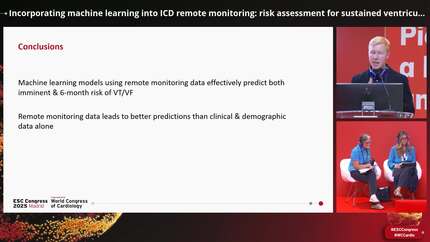
Machine learning using remote monitoring data effectively predicts imminent and six-month VT/VF risk, more than clinical data alone or classical survival models. This work proposes a pathway to integrate ML assessment into remote monitoring, enabling proactive rather than reactive anti-arrhythmia intervention.
Contributors

R Campbell
Author
University College London London , United Kingdom of Great Britain & Northern Ireland

C Monkhouse
Author
B Patel
Author


W Lilaonitkul
Author
A N Bhuva
Author