A novel technique using a pulmonary artery catheter for sheath placement in left bundle branch area pacing
European Heart Journal


Abstract
As Left Bundle Branch Area (LBBA) pacing gains popularity, improving procedural efficiency and safety is crucial. Published pooled data show fluoroscopy times for LBBA pacing exceed 16 minutes. Achieving optimal positioning of dedicated LBB sheaths on the RV septum remains challenging due to the double-curved design, which complicates maneuverability, risks unintended coronary sinus entry, and increases the potential for conduction system injury.
This study aims to describe a novel method for LBB sheath placement using a Pulmonary Artery (PA) catheter and evaluate its safety and efficacy.
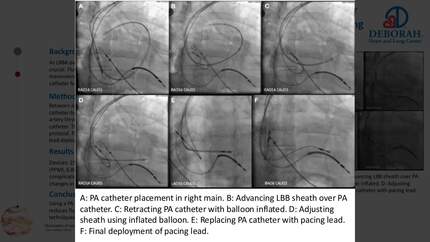
From June of 2023 to February of 2024, data was collected on consecutive cases of LBBA pacing lead placement using the novel method aided by PA catheter. In brief, a standard 7F PA catheter was advanced through specialized LBBA sheaths and positioned in the right main pulmonary artery under fluoroscopy. The sheath was then advanced over the PA catheter to the desired location. PA catheter was then removed and an active pacing lead was placed into the septal location as per standard protocol (Figure). Baseline procedural and clinical parameters were collected and analyzed.
In 48 patients (75.4±10.5 years, 71% male, 44% with cardiomyopathy, LVEF 49.0±11.9%, QRS 134±31 ms), 25 dual-chamber pacemakers, 13 CRT-Ds, 8 CRT-Ps, and 1 ICD were implanted, with 16 involving lead explantation or upgrades. Fluoroscopy times were 6.3±2.9, 6.8±1, and 14.7±4.7 minutes for de novo PPM, ICD, and CRT implants, respectively. LBBA leads were implanted successfully without periprocedural complications. QRS duration shortened by 20±5 ms (P<0.001), with no significant changes in tricuspid regurgitation (P=0.11), mitral regurgitation (P=0.27), or LVEF (P=0.5).
The use of a PA catheter facilitates safer and more efficient LBBA lead placement, reducing fluoroscopy time by one-third compared to published methods.
Contributors

R Gill
Author
G Chang
Author
M Shah
Author
N Markovic
Author
Z Estep
Author
B Bakst
Author
R Viswanathan
Author
P Kazemian
Author
You may be interested in