Comprehensive analysis of adverse events associated with stereotactic arrhythmia radioablation for ventricular tachycardia
European Heart Journal


Abstract
Stereotactic arrhythmia radioablation (STAR) has emerged as a novel non-invasive treatment option for ventricular tachycardia (VT), targeting arrhythmogenic substrates with high precision using ionizing radiation. While STAR shows promise as a therapeutic alternative, the spectrum and severity of its associated adverse events (AEs) remain insufficiently characterized.
To systematically analyze all reported AEs associated with STAR for VT.
The literature search was performed in MEDLINE and EMBASE databases from inception to June 30, 2024 including prospective and retrospective studies, case series and case reports on STAR for monomorphic VT. The search, data extraction and quality assessment were performed by 2 independent investigators with a third investigator adjudicating in case of disagreement. AEs were extracted from eligible studies and classified according to the affected organ system, severity (mild, moderate, severe), and causality (unrelated, possibly related, probably related). When severity was assessed using the Common Terminology Criteria for Adverse Events (CTCAE), the following conversion was applied: grade 1 was categorized as mild, grade 2 as moderate, and grades 3, 4, and 5 were classified as severe. When AE severity was not explicitly reported, the following criteria were used: mild was defined as requiring no intervention, moderate as requiring intervention, and severe as resulting in permanent damage, surgery, or death.
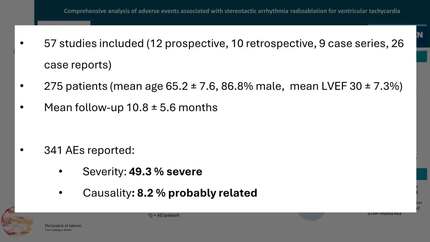
A total of 57 articles were included in the analysis, comprising 12 prospective studies, 10 retrospective studies, 9 case series and 26 case reports. A total of 275 patients were treated with STAR (mean age 65.2 ± 7.6, 86.8% male, mean left ventricular ejection fraction 30% ± 7.3%, 53.3% with ischemic cardiomyopathy) with a mean follow-up time of 10.8 ± 5.6 months. In total, 341 AEs were reported. Of these, 46.92% were classified as unrelated, 44.87% as possible related, and 8.21% as probably related to STAR. In terms of severity, 29.03% of the AEs were classified as mild, 21.70% as moderate and 49.27% as severe. Table 1 shows an overview of the absolute numbers per category. Figure 1 illustrates the distribution of the AEs by organ system. The most frequently reported AEs were heart failure (n=51), fatigue (n=22), nausea (n=17), pericardial effusion (n=15) and pneumonitis (n=13).
While nearly half of the reported AEs were severe, only a small proportion of the AEs were deemed probably related to the STAR treatment. These findings highlight the complexity of the interaction between the patient characteristics and STAR-related AEs.
Contributors

K Poels
Author
R De Roover
Author
S Dymarkowski
Author
J Ector
Author
P Berkovic
Author
B Vandenberk
Author
You may be interested in