Indications, prognosis, and complications of de novo implantable cardioverter defibrillators in patients with type 2 diabetes and without diabetes
European Heart Journal


Abstract
Patients with type 2 diabetes (T2DM) have an increased risk of tachyarrhythmias and require implantable cardioverter defibrillators (ICD) more frequently than those without diabetes (No-DM). However, it remains unclear whether the indication for ICD differs based on the presence of T2DM and how different preventive strategies impact prognosis in patients with T2DM.
The study aims to investigate whether there is a difference in the indication, prognosis and complication rates for ICD-implantation between patients with and without T2DM in different prevention groups.
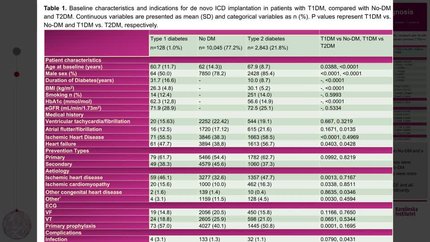
In this retrospective cohort study, 12,885 Swedish patients with de novo ICDs implanted 2010–2021 were followed until December 2021. Data from six national registries were analyzed using chi-square tests for indications and one-year complications, Kaplan-Meier/Cox regressions for outcomes (MACE/all-cause mortality). The primary analysis compared T2DM (n=2,843) and No-DM (n=10,042) across all aspects. Indications/outcomes between T2DM and No-DM were further compared based on whether ICDs were implanted for primary (PP) or secondary prophylaxis (SP). Finally, indications/outcomes were compared within T2DM (PP vs. SP) and similarly within No-DM.
Implantation for a PP was more frequent in T2DM patients (62.7%) than in No-DM patients (54.4%, p<0.0001), with ischemic heart disease (IHD) as the most common etiology in both groups (T2DM: 47.7% vs. No-DM: 32.6%, p<0.0001). No-DM patients more often had non-ischemic etiologies, e.g. dilated cardiomyopathy (17.5% vs. 15.3%, p=0.0066), ARVC (Arrhythmogenic Right Ventricular Cardiomyopathy; 2.6% vs. 0.2%, p<0.0001). ECG-findings such as ventricular tachycardia (25.9% vs. 21.0%) and ventricular fibrillation (20.5% vs. 15.8%) were more prevalent among patients with T2DM than without diabetes (p<0.0001).
T2DM patients had an unadjusted higher risk of all-cause mortality (HR: 1.95 [95% CI: 1.81–2.11]) and MACE (1.87 [1.71–2.05]), which persisted after adjustment for demographics, IHD, and heart failure, with a more pronounced risk in SP than PP. Within T2DM group, PP was associated with lower risk of MACE/All-cause mortality than SP. (Figure.1)
The proportions of complications and infections (1.1% vs. 1.3%, p=0.3814) during the one-year follow-up were comparable between patients with T2DM and No-DM, apart from a higher prevalence of local bleeding among T2DM patients (0.8% vs. 0.3%, p=0.0012).
PP indications was more frequent in T2DM patients undergoing de novo ICD implantation. A likely reason is higher prevalence of comorbidities such as IHD and heart failure. Post-implantation infection rates were similar between both groups but T2DM was associated with worse long-term outcomes, underscoring the need for a comprehensive risk management.

You may be interested in