Development and validation of the MADIT-ICD benefit risk score for Japanese patients - from Nippon Storm study
European Heart Journal


Abstract
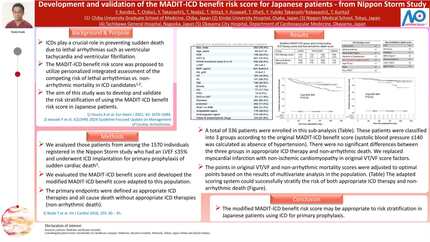
Implantable cardioverter-defibrillators (ICDs) play a crucial role in preventing sudden death due to lethal arrhythmias such as ventricular tachycardia and ventricular fibrillation. The MADIT-ICD benefit risk score was proposed to utilize personalized integrated assessment of the competing risk of lethal arrhythmias vs. non-arrhythmic mortality in implantable cardioverter-defibrillator (ICD) candidates. The aim of this study was to develop and validate the risk stratification of using the MADIT-ICD benefit risk score in Japanese patients.
We analyzed those patients from among the 1570 individuals registered in the Nippon Storm study who had an left ventricular ejection fraction (LVEF) ≤35% and underwent ICD implantation for primary prophylaxis of sudden cardiac death. We evaluated the MADIT-ICD benefit score and developed the modified MADIT-ICD benefit score adapted to this population. The primary endpoints were defined as appropriate ICD therapies and all cause death without appropriate ICD therapies (non-arrhythmic death).
A total of 336 patients (age; 66±11, male; 263 (78%); cardiac resynchronization therapy; 241 (72%) , ischemic cardiomyopathy; 81 (24%)) were enrolled in this sub-analysis. Seventy-six (23%) patients had appropriate ICD therapy and 28 (8.3%) experienced non-arrhythmic death during the mean follow-up period of 788 days. These patients were classified into 3 groups according to the original MADIT-ICD benefit score (systolic blood pressure ≤140 was calculated as absence of hypertension). There were no significant differences between the three groups in appropriate ICD therapy and non-arrhythmic death. We replaced myocardial infarction with non-ischemic cardiomyopathy in original VT/VF score factors. The points in original VT/VF and non-arrhythmic mortality scores were adjusted to optimal points based on the results of multivariate analysis in the population. (Table) The adapted scoring system could successfully stratify the risk of both appropriate ICD therapy and non-arrhythmic death (Figure).
The modified MADIT-ICD benefit risk score may be appropriate to risk stratification in Japanese patients using ICD for primary prophylaxis.



You may be interested in