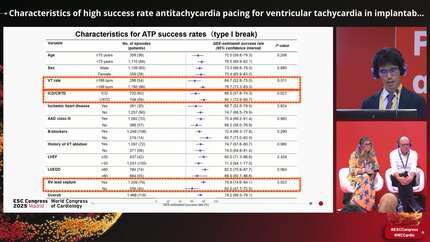
Characteristics of high success rate antitachycardia pacing for ventricular tachycardia in implantable cardioverter-defibrillator recipients: true septal right ventricular lead position as a predictor
European Heart Journal


Abstract
Antitachycardia pacing (ATP) has a potential benefit for shock reduction and improves the quality of life of implantable cardioverter-defibrillator (ICD) recipients; however, its clinical utility and characteristics in these effective populations are unknown.
This study aimed to extract the characteristics leading to a high ventricular tachycardia (VT) termination rate of ATP using a large-scale database of ICD treatments.
Patients who had a history of ≥1 ATP treatment episode from ICD or cardiac resynchronization therapy defibrillator (CRTD) devices were included in the analysis. All appropriate ATP treatments and episodes wherein intracardiac electrograms could be fully traced during the treatment were reviewed. Two endpoints of VT termination were defined: type I break (termination with 0–1 beat after ATP) and clinical endpoint of termination (≤5 beats). We assessed the characteristics associated with a high success rate of ATP using the logistic regression generalized estimating equation (GEE) method.
Of the 756 recipients using high-power devices, 1,468 treatment episodes in 119 patients were analyzed. The VT rate of <188 bpm (vs. ≥188 bpm), CRTD (vs. ICD), and true septum (vs. non-septum) right ventricular (RV) lead position on imaging modality were significantly associated with high success rate of type I break termination (GEE-estimated success rate: 78.7% vs. 64.7%, p=0.011; 80.1% vs. 66.5%, p=0.021; and 79.8% vs. 60.5%, p=0.023, respectively) (Figure 1). Multivariate analysis demonstrated that a slow VT rate of <188 bpm, true septum RV lead position, and the CRTD device were independently associated with a high success rate of termination (Figure 2A). The GEE-estimated success rate across the lead position was highest in the RV true septum (79.8%), followed by the free wall (71.4%), septal hinge (65.2%), inferior hinge (60.8%), and apex (58.7%), and approximately 30% of the patients had RV lead implantation in the non-septum position (Figure 2B). The success rate incrementally increased with the prolonged VT CL (Figure 2C). The pacing QRS interval during ATP on the far-field intracardiac electrograms was significantly shorter in the RV septum group than in the non-septum group (192.9±36.1 ms vs. 215.4±32.8 ms, p=0.036) (Figure 2D). These results were similarly observed in the clinical endpoint of termination (≤5 beats).
True septal deployment of the RV lead is promising for a high ATP success rate after ICD implantation in addition to a slow VT rate and having CRTD recipients. True septal lead implantation has safety benefits and potentiates the efficiency of ATP treatment. Since septal lead deployment is the only manageable and controllable factor that could increase the success rate of ATP post-implantation, it is essential for operators to put every effort into implanting the RV lead in the true septum, which possibly leads to better patient outcomes.
Contributors


Y Inden
Author
Y Sato
Author
R Watanabe
Author
H Miyazawa
Author
K Miyamae
Author
T Iwawaki
Author
T Goto
Author
S Kondo
Author
M Tachi
Author
M Shimojo
Author
Y Tsuji
Author
T Murohara
Author
You may be interested in