Low energy bipolar radiofrequency ablation combined with an inserted intramural electrode can safely create an isolated myocardial lesion underneath thick epicardial fat
European Heart Journal


Abstract
Ventricular arrhythmias (VA) originating from myocardium covered with epicardial fat are difficult to treat by conventional radiofrequency (RF) ablation.
Experimental study (approved by our Institution) was performed to clarify whether low energy bipolar (BIP) RF ablation combined with an inserted intramural plastic needle (equipped with a small electrode tip and temperature sensor) could create myocardial lesions underneath the epicardial fat with a minimum risk of steam-pop.
Healthy porcine hearts were prepared as coronary perfusing lateral wall segments. In an original experimental setting, two ablation catheters were placed on opposite surfaces of each myocardium (epicardial catheter was positioned on the myocardium with rich fat). An 18-gauge plastic needle (equipped with a 3-mm distal electrode tip and a temperature sensor) were inserted in the myocardium underneath the epicardial fat (Figure). Cable-ends of both the epicardial ablation catheter and the 3-mm electrode of the plastic needle were connected together, and these were plugged into the cutaneous electrode connector, whereas cable-end of the endocardial catheter was plugged into the catheter connector of the RF generator. RF energy (10W, 10-g contact, 60-seconds application) was delivered simultaneously between the distal tips of the two ablation catheters and between the 3-mm electrode of the plastic needle and the endocardial ablation catheter.
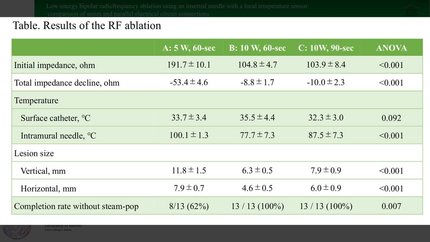
Ablation: BIP ablation was successfully accomplished in all 0/18 applications without steam-pop in the thick myocardium (20.2±1.6 mm) covered with rich epicardial fat (2.3±1.1 mm). Initial impedance, total impedance decline (TID) and %TID measured by the RF generator were 107.2±4.8 ohms, -11.2±2.6 ohms and -10.4±2.4% respectively.
Temperature: Maximum temperatures during RF application at the endocardial ablation catheter and at the inserted temperature monitoring sensor were 35.0±3.5 °C and 81.5±12.1 °C, respectively.
Lesions: BIP ablation created an isolated spherical myocardial lesion under the epicardial fat, surrounding the inserted electrode tip (Figure). Vertical and horizontal diameters of the lesions in the transmural myocardial section were 6.6±0.7 mm and 5.1±0.7 mm, respectively. There were no visual RF lesions at the ablation catheter contacting myocardium on both endocardial and epicardial surfaces.
Discussions: During ablation, current concentration around the small intramyocardial electrode of the plastic needle increased local temperature and created an isolated myocardial lesion. Excessive intramyocardial heating was preventable under monitoring via local temperature sensor.
Low energy BIP ablation combined with inserted intramural electrode and temperature sensor may contribute to improvement of VA ablation, although further studies and technological adjustments are definitely required before clinical use.
Contributors

You may be interested in