Cold saline catheter irrigation allows performing long application time bipolar radiofrequency ablation for creating deep lesions with a minimum risk of steam-pop
European Heart Journal


Abstract
Long application time bipolar (BIP) radiofrequency (RF) ablation, which maximally utilizes conductive heating effect, is useful to treat ventricular arrhythmias (VA) originating from inside the thick myocardium, although this method has a relatively high risk of steam-pop occurrence underneath the surface myocardium.
Experimental study (approved by the Animal Studies Subcommittee of our Institution) was performed to clarify whether cold saline irrigation through RF ablation catheters could prevent excessive heating under the catheter contacting myocardium, and would allow long application time RF ablation for creating deep lesions in the thick myocardium with a minimum risk of steam-pop.
Healthy porcine hearts were prepared as coronary perfusing lateral wall segments (17.5±2.3 mm thickness). In an original experimental setting, two ablation catheters were placed on opposite surfaces of each myocardium, and BIP ablation (40W, 20-g contact, 13-ml/min irrigation) was attempted. The following 3 methods were performed; 120-seconds ablation using room temperature saline (RT) and 4 °C cold saline (Cold) irrigation in 30 applications each (RT-120, Cold-120), and 150-seconds ablation using Cold saline (Cold-150) irrigation in an additional 30 applications.
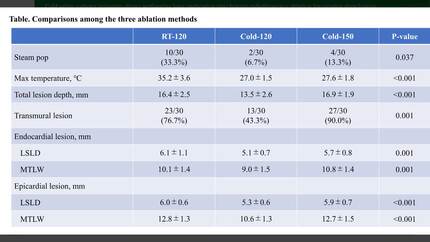
Steam-pop: As shown in the Table, steam-pop occurred in 10/30 applications (33.3%) in RT-120, in 2/30 applications (6.7%) in Cold-120, and in 4/30 applications (13.3%) in Cold-150. Incidence of steam-pop in RT irrigation was greater than that in Cold irrigation methods.
Temperature: Maximum temperature during RF application at the ablation catheter were higher in RT-120 than those in either Cold-120 or Cold-150 (Table).
Lesions: Total lesion depth (endocardial plus epicardial lesion depth in non-transmural lesions, and myocardial thickness at the ablation site in the transmural lesions) was deeper in RT-120 than that in Cold-120, but not different between RT-120 and Cold-150 (Table). Transmural lesions were created in 23/30 applications in RT-120, in 13/30 applications in Cold-120, and in 27/30 applications in Cold-150. Cold-120 created smaller longest surface lesion diameter (Long-SLD) and maximum lesion width under the surface (Max-LUS) as compared to those in RT-120 (Table), but these parameters were not different between RT-120 and Cold-150.
Since Cold-150 created similar lesion depth with a lower incidence of steam-pop than in RT-120, long application time BIP ablation with cold saline irrigation has the potential to create deeper lesion without increasing steam-pop. This technique would be simply performable and contribute to improvement of ablation for VA in most clinical settings.
Contributors

You may be interested in