Effect of glucagon-like peptide-1 agonists on ventricular tachycardia ablation outcomes
European Heart Journal


Abstract
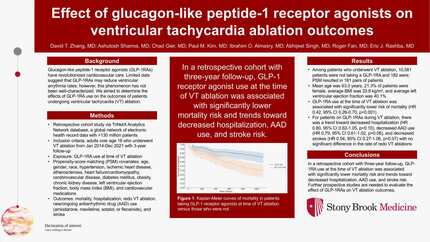
Glucagon-like peptide-1 (GLP-1) agonists have revolutionized cardiovascular care. Limited data suggest that GLP-1 may reduce ventricular arrythmia rates; however, this phenomenon has not been well-characterized.
To determine the effects of GLP-1 agonist use on the outcomes of patients undergoing ventricular tachycardia (VT) ablation.
Our retrospective cohort study was conducted using the TriNetX Analytics Network database, a global network of electronic health record data that includes over 130 million patients. This study evaluated adults over age 18 who underwent VT ablation, captured by Current Procedural Terminology codes, from January 2014 to December 2021. Patients were grouped based on GLP-1 agonist use at the time of ablation. Propensity-score matching (PSM) was performed in a 1-to-1 fashion with the following covariates: age, gender, race, hypertension, ischemic heart disease, atherosclerosis, heart failure, cardiomyopathy, cerebrovascular disease, diabetes mellitus, obesity, chronic kidney disease, left ventricular ejection fraction, body mass index (BMI), and cardiovascular medications. Mortality, hospitalization, redo VT ablation, new/ongoing antiarrhythmic drug (AAD) use, and stroke were analyzed from the date of the procedure to three years after index VT ablation.
Among patients who underwent VT ablation, 10,581 patients were not taking a GLP-1 agonist and 182 were prescribed one. After PSM, 181 pairs of patients were analyzed. Mean age was 63.0 years, 21.3% of patients were female, average BMI was 33.8 kg/m2, and average left ventricular ejection fraction was 40.1%. GLP-1 agonist use at the time of VT ablation was associated with significantly lower risk of mortality (HR 0.42, 95% CI 0.26-0.70, p<0.001). For patients on GLP-1 agonists during VT ablation, there was a trend toward decreased hospitalization (HR 0.80, 95% CI 0.62-1.05, p=0.10), decreased AAD use (HR 0.79, 95% CI 0.61-1.02, p=0.06), and decreased strokes (HR 0.54, 95% CI 0.27-1.06, p=0.07). No significant difference in the rate of redo VT ablations was observed.
In a PSM cohort with a three-year follow-up, GLP-1 agonist use at the time of VT ablation was associated with significantly lower mortality risk and trends toward decreased hospitalization, AAD use, and stroke risk. Further prospective studies are needed to evaluate the effect of GLP-1 agonists on VT ablation outcomes.
Contributors

A Sharma
Author
C Gier
Author
P M Kim
Author
I O Almasry
Author
A Singh
Author
R Fan
Author
E J Rashba
Author
You may be interested in