Improved survival with AED-only training in a public-access defibrillation program: a 23-year database analysis of project Vita
European Heart Journal


Abstract
Out-of-hospital cardiac arrest (OHCA) is a significant public health challenge.
Early defibrillation is crucial to manage fatal arrhythmias. The use of automated external defibrillators (AEDs) is a promising tool in enhancing survival.
Progetto Vita (PV) in our city pioneered the first community-based AED project in Europe.
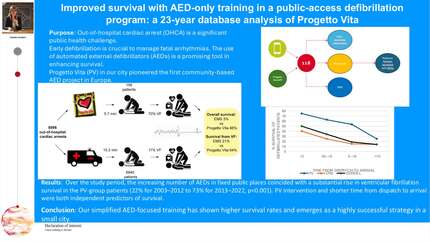
We present survival data spanning 23 years for all OHCA cases. A total of 6996 OHCAs were recorded. Among these, 156 case were managed by PV volunteers (PV-group). The PV-group managed a significantly higher proportion of shockable rhythms than the EMS group (69.9% vs. 10.9%). Mean time to arrival was shorter (5.7 vs. 10.2 minutes), and survival rates better (46.2% vs. 2.9%, overall). Survival rates declined with time. However, a higher proportion of patients in the PV-group demonstrated favorable neurological outcomes, even up to 9 minutes from the call.
Over the study period, the increasing number of AEDs in fixed public places coincided with a substantial rise in ventricular fibrillation survival in the PV-group patients (22% for 2003–2012 to 73% for 2013–2022, p<0.001). Table 2 shows independent predictors of survival. In conclusion our simplified AED-focused training has shown higher survival rates and emerges as a highly successful strategy in a small city. Independent predictors of survival
Contributors


L Rossi
Author
S Ferraro
Author
M G Bolognesi
Author
M S Pisati
Author
E Ferdenzi
Author
S Nani
Author
V Pelizzoni
Author
You may be interested in