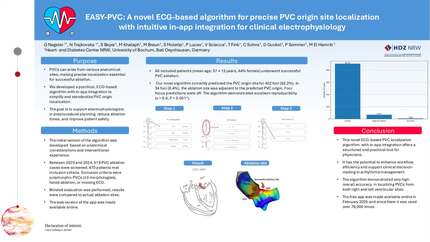
EASY-PVC: a novel ECG-based algorithm for precise PVC origin site localization with intuitive in-app integration for clinical electrophysiology
European Heart Journal


Abstract
Premature Ventricular Contractions (PVCs) can originate from various anatomical sites, requiring precise localization for effective catheter ablation. Current localization methods rely heavily on physician experience and complex ECG interpretation. While existing algorithms provide some useful guidance, they can be intricate and challenging to use in clinical practice.
To develop and evaluate a comprehensive PVC localization algorithm with a simple and user-friendly in-app integration, assisting electrophysiologists in identifying the likely origin of PVCs based on 12-lead ECG characteristics, thereby facilitating preprocedural ablation planning, shortening ablation times, and increasing patient safety.
The initial version of the algorithm was developed retrospectively and empirically, based on anatomical considerations and interventional experience. It was then tested, refined during clinical practice, and subsequently validated prospectively once we gained confidence in its performance.
Between 2020 and 2024, a total of 519 patients underwent PVC ablation at our center. They were evaluated in a blinded manner by a cardiology resident and an experienced electrophysiologist using the Easy PVC algorithm. However, 49 cases were excluded due to pronounced PVC polymorphism, unsuccessful ablation, or the absence of a prior 12-lead ECG tracing. PVC polymorphism was defined as three or more PVC morphologies. 470 patients were included in the prospective validation. The algorithm's results were then compared to the actual ablation site. The web version of the app was made available online.
All included patients (mean age: 57 ± 12 years, 44% female) underwent successful PVC ablation. Our novel algorithm correctly predicted the PVC origin site for 452 foci (92.2%). In 34 foci (8.4%), the ablation site was adjacent to the predicted PVC origin. Four focus predictions were off. The algorithm demonstrated excellent reproducibility (κ > 0.8, P < 0.001*).
This novel ECG-based PVC localization algorithm with in-app integration offers a structured and practical tool for physicians, with the potential to enhance workflow efficiency and support clinical decision-making in arrhythmia management. Further studies will evaluate its impact in real-world practice. Furthermore, the free app was made available online. Global user feedback highlighted the integrated app's efficiency and ease of use, particularly benefiting early-career electrophysiologists.

You may be interested in