Gene-specific risk models in genetic dilated cardiomyopathy for implantable cardioverter defibrillator decisions: a critical perspective on limitations and applicability
European Heart Journal


Abstract
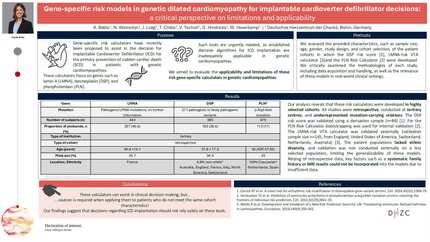
Gene-specific risk calculators have recently been proposed to assist in the decision for Implantable Cardioverter Defibrillator (ICD) for the primary prevention of sudden cardiac death (SCD) in patients with genetic cardiomyopathies. These calculators focus on genes such as lamin A (LMNA), desmoplakin (DSP), and phospholamban (PLN) [1-3]. Such tools are urgently needed, as established decision algorithms for ICD implantation are inadequately applicable in genetic cardiomyopathies. However, the applicability of these scores in clinical practice still needs to be investigated.
We aimed to evaluate the applicability and limitations of these risk gene-specific calculators in genetic cardiomyopathies.
We assessed the provided characteristics, such as sample size, age, gender, study design, and cohort selection, of the patient cohorts in which the DSP risk score [1], LMNA-risk VTA calculator [3]and the PLN Risk Calculator [2] were developed. We critically examined the methodologies of each study, including data acquisition and handling, as well as the relevance of these models in real-world clinical settings.
The studies included in our analysis presented cohort sizes ranging from 385 to 679 participants. The proportion of female participants varied between 17% and 46%. The average age of participants was approximately 40 years. The proportion of probands varied from 17 to 46.6%. All studies included were retrospective in nature and used data sourced from tertiary institutions located in North America, Australia, and Western Europe (see Table 1). The DSP risk score was validated using a derivation sample (n=86) [1]. For the PLN Risk Calculator bootstrapping was used for internal validation [2]. The LMNA-risk VTA calculator was validated externally (validation sample size n=145, from England, United States of America, Switzerland, Netherlands, Australia) [3].
Our analysis reveals that these risk calculators were developed in highly selected cohorts, potentially introducing several types of bias. Notably, all studies were retrospective, conducted at tertiary centers, and underrepresented mutation-carrying relatives. Furthermore, the patient populations lacked ethnic diversity, and validation were non conducted externally on a less selected population, limiting the generalizability of these models. Relying of retrospective data, key factors such as a systematic family history or MRI results could not be incorporated into the models due to insufficient data. While these calculators can assist in clinical decision-making, caution is required when applying them to patients who do not meet the same cohort characteristics. Our findings suggest that decisions regarding ICD implantation should not rely solely on these tools. Further prospective, multi-center studies with diverse populations are necessary to validate and improve the accuracy of these calculators for broader clinical use.
Contributors


N Wainstejn
Author
J Lueg
Author
T Chiba
Author
V Tscholl
Author
G Hindricks
Author
W Haverkamp
Author
You may be interested in