Men do have more PVCs than women - but mainly because they are taller
European Heart Journal


Abstract
Premature ventricular complexes (PVCs) are commonly regarded as more frequent in men, yet studies on PVC risk factors demonstrate contradictory results.
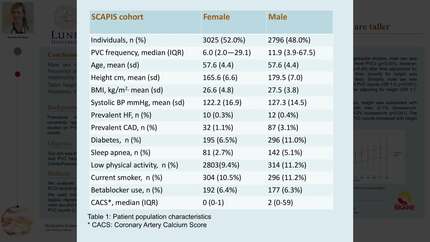
Our aim was to study the association between male sex and PVC frequency in the population-based Swedish CArdioPulmonary bioImage Study (SCAPIS) cohort.
We analyzed 5,821 SCAPIS individuals with 24-hour ECG recordings without atrial fibrillation. We used multivariable robust linear regression and logistic regression to model the relationships between male sex and ln-transformed PVC frequency or elevated PVC counts (≥75th percentile), respectively. Models were stepwise adjusted for age, body mass index, systolic blood pressure, coronary artery calcium score, diabetes, coronary artery disease, sleep apnea, heart failure, low physical activity, smoking status, betablocker use and height.
The mean age was 57.6 years, mean height was 172.3 cm, and 48% were male. The median daily PVC count was 8.7 (IQR 3.0-44.0). Male sex was associated with 54.6% more PVCs (p<0.001), but this reduced to 6.0% (p=0.46) after final adjustment for height. Similarly, male sex was associated with elevated PVC counts (OR 1.5, p<0.001), but lost significance after adjusting for height (OR 1.1, p=0.49). In sex stratified analysis, height was associated with PVC frequency in both men (2.1% increase/cm, p<0.001) and women (3.0% increase/cm, p<0.001).
Male sex is associated with higher PVC frequency and elevated PVC counts, but this relationship is largely mediated by height. Height independently influences PVC frequency, regardless of sex.
Contributors



You may be interested in