Right ventricular dysfunction: an overlooked predictor of sudden cardiac death and arrhythmic events: a meta-analysis
European Heart Journal


Abstract
Right ventricular (RV) dysfunction has been associated with adverse cardiac outcomes, including sudden cardiac death (SCD) and ventricular arrhythmia (VA). However, its prognostic relevance remains unclear.
To conduct a meta-analysis to determine the prognostic value of RV dysfunction -assessed by RV fractional area change (RVFAC), RV ejection fraction (RVEF), and RV strain - in risk stratification for SCD and VA. In a separate analysis, we compared the prognostic value of RV function to left ventricular function (assessed by left ventricular ejection fraction, LVEF).
A systematic literature search was performed using PubMed, Embase, and Web of Science from inception to February 2025. The primary endpoint was a composite of SCD or VA, including ventricular tachycardia or fibrillation, along with appropriate implantable cardioverter-defibrillator Therapy. RV dysfunction was defined as an impairment, indicated by decreased RVFAC (at least <35%, two studies) and RVEF values (at least <45%, four studies) or a threshold for RV strain (>-20%, one study). LVEF was entered a continuous variable. Data extraction was performed independently by two reviewers, and discrepancies were resolved by consensus. A pooled risk ratio (RR) was calculated using a random-effects model to assess the association between RV function and LV function and adverse outcomes, with 95% confidence intervals (CI).
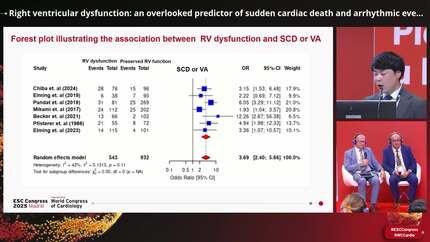
Initially, 1,296 articles were screened, and after reviewing 44 full-text articles, seven studies were included in the meta-analysis, encompassing a total sample size of 1,475 patients. Among these, RV dysfunction was present in 541 patients. The mean follow-up duration was 2.9 years. Our analysis revealed that RV dysfunction was significantly associated with an increased risk of SCD and VA (RR: 3.73, 95% CI: 2.43 to 5.72, p<0.01) (Figure 1). LVEF data were available from three studies. While RV dysfunction, assessed by RVFAC, remained significantly associated with SCD and VA (MD: -5.67, 95% CI: -8.73 to -2.60, P<0.01) (Figure 2a), this was not the case for LVEF (MD: -0.59, 95% CI: -4.10 to 2.92, P=0.74) (Figure 2b).
Our analysis demonstrates that RV dysfunction is significantly associated with SCD and VA. Regarding its prognostic value, RV dysfunction appears superior to LVEF alone. These findings highlight the importance of assessing RV function in risk stratification and clinical decision-making for patients at risk of SCD.
Contributors


A Beblo
Author
N Wainstejn
Author
J Lueg
Author
R Hattasch
Author
F Hohendanner
Author
V Tscholl
Author
N Dagres
Author
G Hindricks
Author
W Haverkamp
Author
You may be interested in