Electrocardiogram-based QRS analysis predicts ventricular arrhythmias in patients after cardiac electronic device implantation: a prospective study
European Heart Journal


Abstract
Electrocardiogram (ECG)-based QRS analysis provides non-invasive electrophysiological information and may be valuable for predicting ventricular arrhythmias (VAs).
We aimed to evaluate whether QRS voltage and morphology predict VAs in patients after cardiac implantable electronic device (CIED) implantation.
In this prospective study, patients underwent a five-minute ECG recording analyzed using Resting HyperQ, which automatically calculated the limb-to-chest QRS mean peak voltage ratio and the high-frequency morphology index (HFMI). The primary outcome was the occurrence of VAs, defined as sustained ventricular tachycardia, ventricular fibrillation, or appropriate implantable cardioverter-defibrillator therapy.
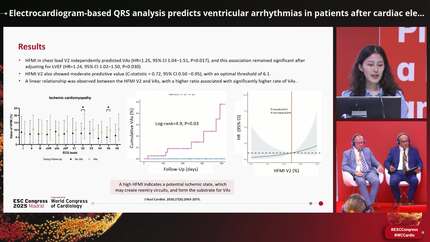
Among 242 patients (mean age 56.3 ± 15.6 years; 70.2% male), 61 (25.2%) had ischemic cardiomyopathy (ICM). Over a median follow-up of 233 days, 13 (5.4%) experienced VAs. The limb-to-chest voltage ratio significantly predicted VAs (HR=1.97, 95% CI 1.03–3.79, P=0.041), and this association remained significant after adjusting for left ventricular ejection fraction (LVEF; HR=2.34, 95% CI 1.09–5.00, P=0.029). The ratio demonstrated moderate predictive value (C-statistic = 0.68, 95% CI 0.51–0.85), with an optimal threshold of 0.65. A linear relationship was observed between the limb-to-chest voltage ratio and VAs, with a higher ratio associated with significantly higher rate of VAs. In the ICM subgroup, HFMI in chest lead V2 independently predicted VAs (HR=1.25, 95% CI 1.04–1.51, P=0.017), and this association remained significant after adjusting for LVEF (HR=1.24, 95% CI 1.02–1.50, P=0.030). HFMI V2 also showed moderate predictive value (C-statistic = 0.72, 95% CI 0.50 –0.95), with an optimal threshold of 6.1. A linear relationship was observed between the HFMI V2 and VAs, with a higher ratio associated with significantly higher rate of VAs .
ECG-based QRS voltage and morphology analysis, particularly the limb-to-chest voltage ratio and HFMI in chest lead V2, may serve as valuable non-invasive markers for identifying patients at risk for VAs.


You may be interested in