Competing risks of ventricular tachyarrhythmias and mortality in advanced heart failure: impact of left ventricular ejection fraction
European Heart Journal


Abstract
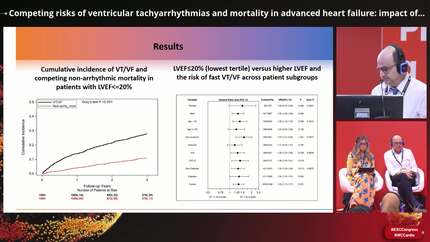
Patients with heart failure and low left ventricular ejection fraction (LVEF) are at higher risk of death from ventricular tachycardia or ventricular fibrillation (VT/VF), pump failure, or non-cardiac causes. This study aimed to assess the association between LVEF and VT/VF risk, considering non-arrhythmic mortality as a competing factor.
The study comprised 5,168 primary prevention implantable cardioverter defibrillator (ICD) recipients from five major trials (MADIT-II, MADIT-CRT, MADIT-RIT, MADIT-RISK, RAID), categorized by LVEF tertiles (EF ≤20%, EF 21-29%, EF 30-35%). Outcomes included VT/VF, VT over 200 BPM or VF, appropriate ICD shocks, and mortality, with Fine and Gray regression models used to adjust for death as a competing risk in arrhythmia outcomes.
At 3 years of follow-up, the cumulative incidence of VT/VF was 28% in patients with LVEF ≤20% (n=1504), 23% in those with LVEF 21–29% (n=2011), and 20% in the LVEF 30-35% (n=1653) group (Gray’s test, p<0.001, Figure). Multivariate analysis revealed that compared to patients with EF >20%, patients with EF ≤20% had significant 23% increased risk of VT/VF (p=0.004), 33% increased risk of fast VT/VF (p=0.001), and 31% increased risk of appropriate ICD shocks (p=0.003), even after accounting for competing risks of death. This increased VT/VF risk in lower EF patients was consistent across different subgroups, including age, sex, presence of CRT-D, and non-ischemic cardiomyopathy. Additionally, patients with EF ≤20% had a 1.5-fold higher risk of all-cause mortality compared to those with EF >20% (p<0.001).
Patients with very low LVEF show a markedly increased risk of VT/VF and ICD shocks, even when considering the competing risk of non-arrhythmic mortality, confirming the potential benefit of ICD therapy in this high-risk population.
Contributors

I Goldenberg
Author
K Buturlin
Author
A Erez
Author
G Goldenberg
Author
B Polonsky
Author
S Mcnitt
Author
M Aktas
Author
W Zareba
Author
G Golovchiner
Author
You may be interested in