Impact of physical activity restriction in patients with arrhythmogenic dysplasia on the development of cardiovascular risk factors
European Heart Journal


Abstract
High-intensity physical activity and competitive sports are not recommended for patients with arrhythmogenic dysplasia. This restriction may lead patients to develop a fear of low/moderate-intensity physical activity, promoting a sedentary lifestyle, and increasing the prevalence of cardiovascular risk factors. Our objective is to analyze the reduction in physical activity after the diagnosis of arrhythmogenic dysplasia and its impact on the development of cardiovascular risk factors.
We collected data from 72 consecutive patients with arrhythmogenic dysplasia between 1996 and 2021 at two tertiary hospitals with a family heart disease unit. Using accelerometry, we gathered data on daily physical activity for four weeks, including daily hours of inactivity, light, moderate, and vigorous physical activity. Interviews were conducted to collect the average physical activity time in the five years prior to diagnosis and in the last three months. Clinical histories were reviewed to collect baseline characteristics and cardiovascular risk factors prevalence (Figure 1). Paired Student's t-test was used to compare physical activity levels before and after diagnosis. Independent samples t-student was used to analyze differences in physical activity according to each cardiovascular risk factors.
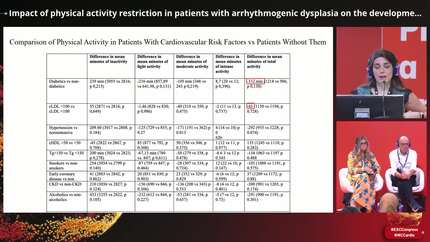
(Figure 2). Physical activity decreased by an average of 122 minutes from the 5 years prior to the arrhythmogenic dysplasia diagnosis compared to the last 3 months. The average minutes of physical activity were lower in all groups with the presence of each cardiovascular risk factors, but without statistical significance. The average physical activity in diabetics was 312 minutes lower than in non-diabetics. Normotensive patients engaged in 292 minutes more physical activity than hypertensive patients. Patients with cLDL<100 mg/dl performed 43 minutes more physical activity than those with cLDL>100 mg/dl. Patients with cHDL>50 mg/dl engaged in 135 minutes more physical activity; those with Tg>150 mg/dl performed 134 minutes less physical activity than those with Tg<150. Patients with chronic kidney disease performed 300 minutes less physical activity than those with normal renal function. Non-smokers performed 103 minutes more physical activity than smokers. Alcoholic patients engaged in 291 minutes less physical activity than non-alcoholic patients. Paradoxically, patients with coronary artery disease engaged in a slightly higher average physical activity, probably due to education on healthy lifestyle habits.
In our study, we observed an association between the restriction of high-intensity physical activity and increased sedentarism, which was associated with an increase in cardiovascular risk factors. This highlights the importance of promoting safe physical activity in patients with arrhythmogenic dysplasia. Baseline characteristics Results
Contributors

You may be interested in