Impact of coronary chronic total occlusion revascularization on ventricular arrhythmias and cardiac death: a systematic review and meta-analysis
European Heart Journal


Abstract
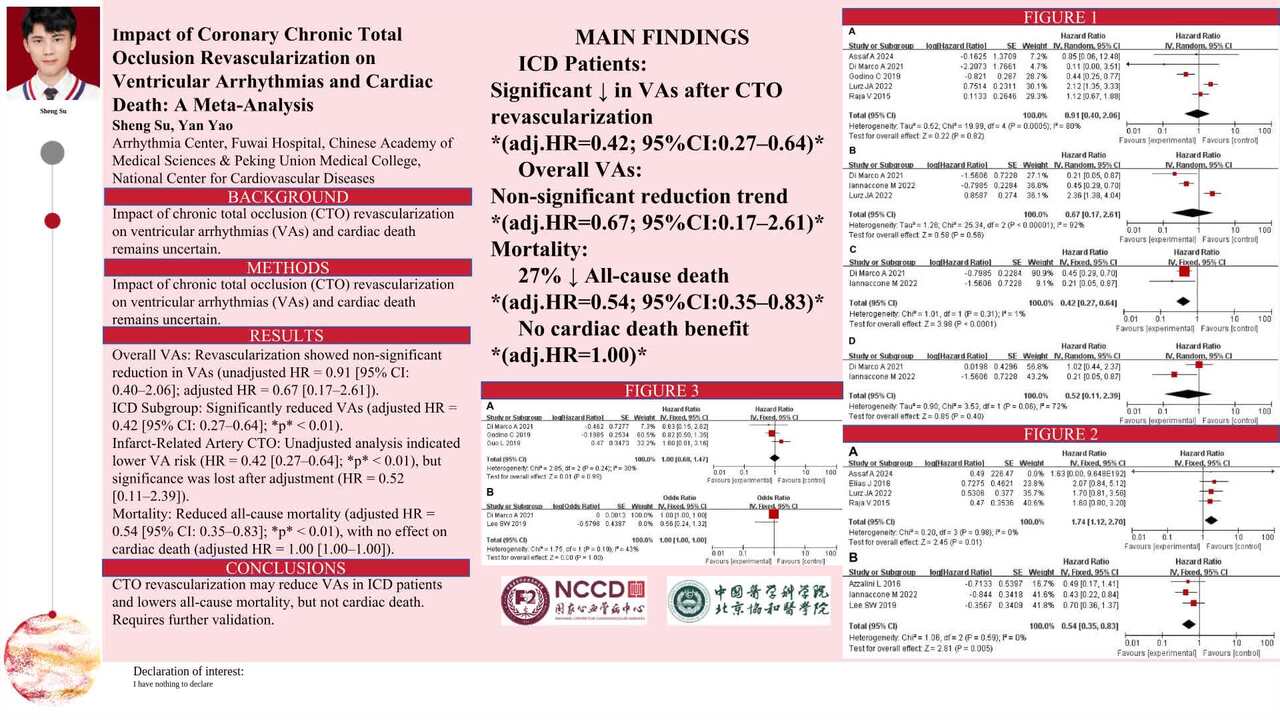
This study aimed to examine the relationship between chronic coronary artery total occlusion (CTO) revascularization and the occurrence of ventricular arrhythmias (VAs) and cardiac death.
CTO is a significant problem in patients with ischemic heart disease. However, whether VAs and cardiac death could be prevented by revascularization are unclear. Therefore, a systematic review and meta-analysis were conducted to examine the relationship between CTO revascularization and the VAs.
Potential papers published from inception to July 2024 were identified through a systematic search of PubMed and Embase databases. The primary endpoint was the incidence of VAs during follow up. The VAs includes ventricular tachycardia/ventricular fibrillation or appropriate implantable cardioverter-defibrillator (ICD) therapy. Pooled risk ratios were estimated using fixed- or random-effects meta-analysis. Sensitivity analyses were conducted to assess the influence of revascularization of CTO on the pooled VAs risk.
Our meta-analysis encompassed 10 studies representing a total of 5,966 patients. Overall, our meta-analysis indicates that CTO revascularization may be associated with a reduced incidence of VAs, though this finding is not statistically significant. The unadjusted hazard ratio (HR) was 0.91 [95% confidence interval (CI): 0.40-2.06, I²=80%, p=0.82], while the adjusted HR was 0.67 (95% CI: 0.17-2.61, I²=92%, p=0.56). In the patients with ICD, CTO revascularization may significantly reduce the incidence of VAs (adjusted HR 0.42, 95%CI, 0.27-0.64, I2=1%, p< 0.01). In the infarct-related artery CTO, the revascularization may reduce the incidence of VAs (unadjusted HR 0.42, 95% CI: 0.27-0.64, I²=1%, p<0.01), this effect did not reach statistical significance after adjustment (adjusted HR 0.52, 95% CI: 0.11-2.39, I²=72%, p=0.40). Revascularization for CTO can improve all-cause mortality (adjusted HR, 0.54; 95%CI, 0.35-0.83, I2=0%, p< 0.01), but has little effect on the outcome of cardiac death (adjusted HR, 1.00; 95% CI, 1.00-1.00, I2=43%, p= 1.00).
The meta-analysis indicates that revascularization of CTO may be associated with a decreased risk of VAs in patients, and this relationship is particularly significant in patients with ICD. Further research is needed to confirm these findings.


You may be interested in