Next-generation cardiomyopathy models: CRISPR/Cas9-edited pigs for personalized cardiac therapeutics
European Heart Journal


Abstract
Hereditary arrhythmogenic cardiomyopathy (ACM) and hypertrophic cardiomyopathy (HCM) are autosomal dominant inherited heart diseases responsible for most cases of sudden cardiac death in healthy people aged younger than 35, specially in young athletes. Modelling these disorders in large animals is expected to serve as an invaluable resource for investigating disease-specific pathways and mutation impacts. Moreover, by facilitating rigorous preclinical testing, it opens avenues for developing targeted gene therapies.
We have established a working pipeline for generating genetically modified pig models using CRISPR/Cas9 technology to investigate key cardiac proteins involved in hereditary heart conditions. Specifically, this initiative aims to create large animal models with targeted mutations in the TMEM43, PKP2 and MYBPC3 genes.
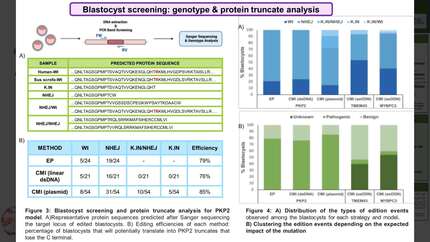
Our methodology involves maturing oocytes from pig ovaries, followed by in vitro fertilization with Yucatan pig semen. Prior fertilization, oocytes undergo CRISPR/Cas9-mediated genetic modification via electroporation (EP) or cytoplasmic microinjection (CMI) with Cas9 proteins and specific guide RNAs (gRNAs). Furthermore, we have established the surgical procedures required for embryo transfer. Surrogate sows, prepared through hormonally induced heat cycles, undergo an abdominal laparotomy to insert CRISPR-modified embryos containing PKP2 mutations directly into the oviduct.
Post-fertilization viability rates are 33-36%, and development to the blastocyst stage is achieved in 11-12% of cases for EP and 18% for CMI. Among these, CMI has proven the most efficient, particularly for the PKP2 model, where an impressive 80% of blastocysts exhibit successful gene editing. This high success rate marks a significant advance in generating precise and robust large-animal disease models. In our first trial, ultrasound monitoring of the gilt at day 35 post-surgery revealed successful implantation of seven embryonic vesicles in the uterine wall. Although the development of these fetuses was naturally interrupted before they reached term, the implantation of the embryos constituted the first major challenge initially presented by the transfer process. Consequently, we are currently working on improving the pregnancy diagnostics and monitoring of the pregnant sow in future transfers to obtain our first generation of genetically modified piglets after a gestation period of 115 days.
By applying cutting-edge gene-editing techniques on pig oocytes, we aim to produce animal models that replicate human cardiac disease pathology with high fidelity, enhancing their translational potential for understanding disease mechanisms and testing new therapies. As such, this work represents a major step toward the implementation of personalized therapeutic strategies in cardiology, bridging the gap between molecular insights and clinical application. Distribution of mutations in blastocysts Ultrasound of developing embryo at 35d
Contributors

M Clemente
Author
N Garcia
Author
C Galan
Author
D Martin
Author
J M Fernandez-Toro
Author
B Ibanez
Author
J Alegre-Cebollada
Author
J D D Hourcade
Author
J A Bernal
Author
E Lara
Author
You may be interested in