Piezoelectric energy harvesting for leadless pacing: a novel inertial energy harvester tuned to cardiac dynamics
European Heart Journal


Abstract
Energy harvesters that convert biomechanical energy into electrical power could be used for implantable devices, providing a near infinite energy solution. While various energy harvesters with piezoelectric or triboelectric elements have been designed and applied to the cardiac environment, none have been successfully integrated into leadless pacemakers due to their size constraints or insufficient energy generation.
This study aimed to develop a proprietary inertial piezoelectric energy harvester (PEH) capable of generating the energy required for a self-sustaining leadless pacemaker from the beating of the heart.
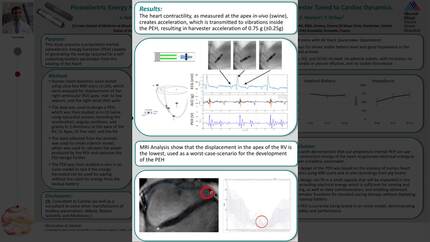
Human heart dynamics were tested using ultra-fast MRI scans of 20 patients, which were analyzed for displacement of the right ventricular (RV) apex, mid- to low septum, and the right atrial (RA) walls. The data was used to design the PEH, which was evaluated in thirteen (13) male swine. In addition, epicardial MEMS-based sensors recorded the acceleration, angular positions, and gravity in 3 directions. The sensors were placed at the apex of the RV, LV Apex, LV free wall, and the RA using adhesive means. The data collected from the animals was used to calculate the power produced by the PEH in the different regions of interests and to create a bench model to optimize the PEH design further. The PEH was then tested in-vivo in an ovine model.
The heart contractility creates harmonic acceleration in the heart tissue, transmitting this vibration into the PEH, resulting in the harvester acceleration of 0.75 g (±0.25g). When the PEH is subject to vibrations, the PEH oscillates using kinetic forces exerted on the piezoelectric beam through a proof mass, transforming these mechanical forces into electric energy. The electrical energy produced using this PEH is 6µW (± 2µW), which is sufficient to power a leadless pacemaker, providing pacing therapy of 100% pacing, at 60 BPM, with heart impedance of 600 (±200), and a pacing voltage reaching 2V, with sufficient excess energy to maintain charge of a secondary battery used for communication and advanced pacemaker functions. This was then tested in a pre-clinical setup, using an ovine model (results to be presented in the future).
This work demonstrates that a proprietary inertial PEH can use the contraction energy of the heart to generate electrical energy. The design of the PEH was based on the analysis of human heart kinetics using MRI scans and in-vivo recordings from pigs’ hearts. This design of an effective energy harvester can produce enough energy to power a leadless pacemaker. The design can fit in a small capsule that can be used in a leadless pacemaker that will be implanted in the RV providing sensing and pacing as well as daily communication enabling advanced pacemaker functions. The PEH is currently being tested in an ovine model, demonstrating its safety and performance.




You may be interested in